





#1 MCINTOSH (also #37)
“U.S. Department of Agriculture Pomological Watercolor Collection. Rare and Special Collections, National Agricultural Library, Beltsville, MD 20705”
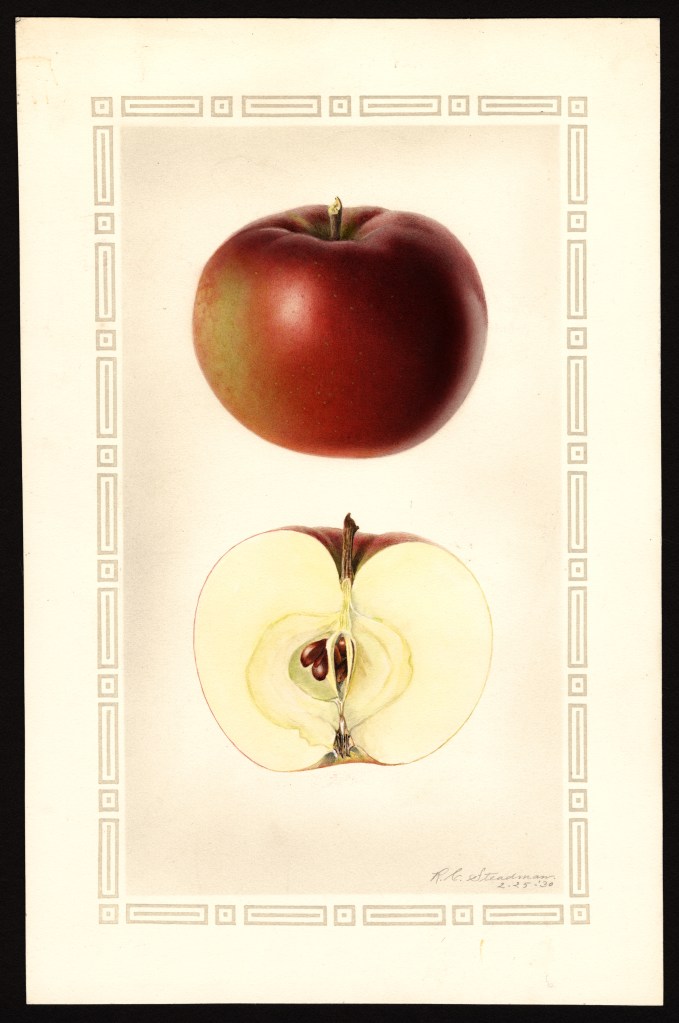
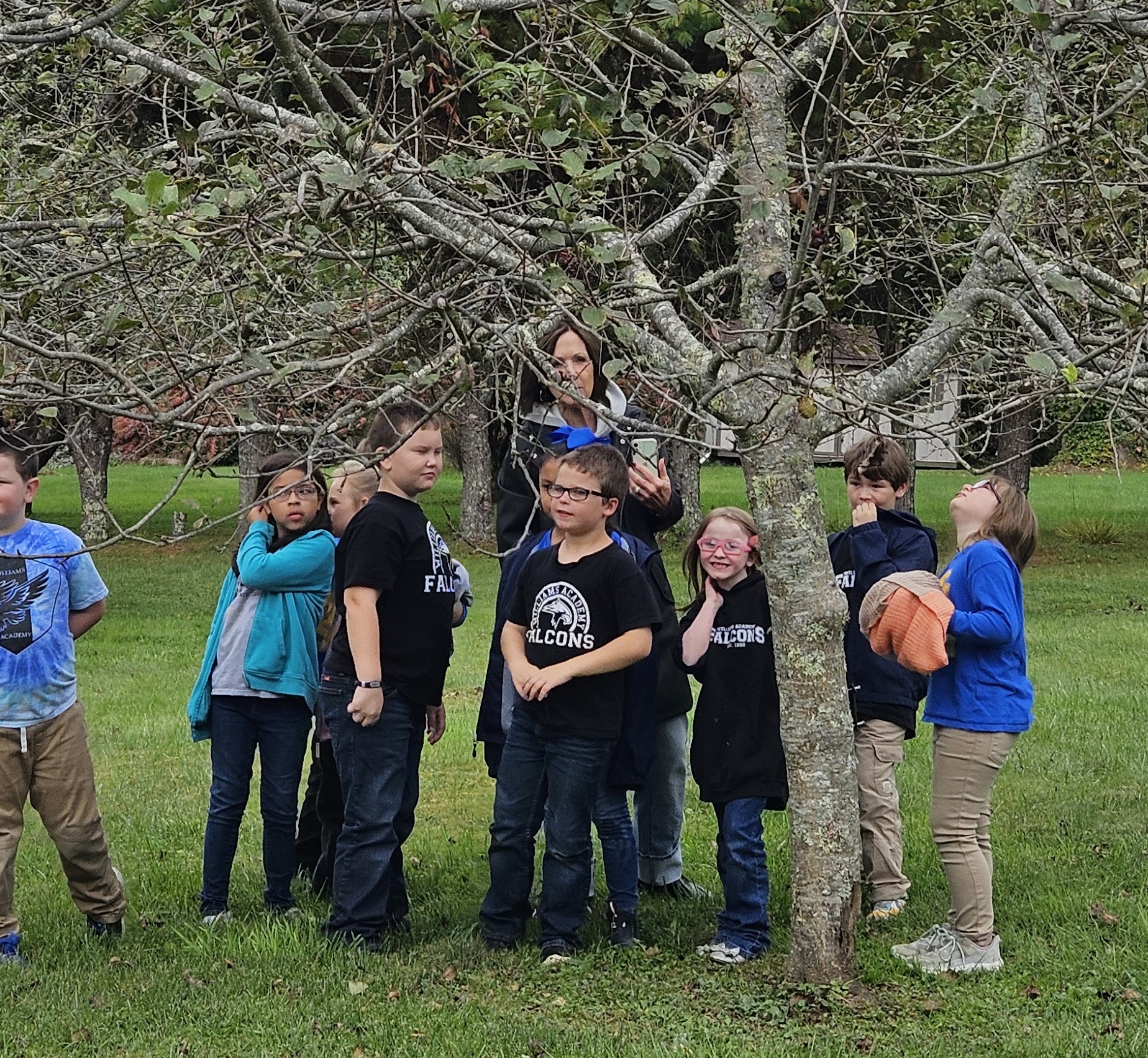
McIntosh– (also known as McIntosh Red) The Crossnore Heritage Orchard has two McIntosh apple trees, Tree #1 and Tree #37. Our McIntosh apples begin ripening in August and continues over a relatively long period of time. Even though McIntosh apples come from a most northern location they do very well and are quite popular here. I’ve commonly seen Older McIntosh trees around Avery County. Please share with us your stories about the McIntosh if you have some. We can post them on this website, if you wish.
The McIntosh was discovered in 1811 as a young seedling tree in Dundas County, Ontario, Canada by John McIntosh, an American who had recently emigrated to the area from New York state. By 1835, he was selling grafted trees which quickly became local favorites, producing apples sought after for their great flavor, dependability, and keeping qualities. The original tree at the McIntosh homestead finally blew down and died in 1910. McIntosh apples became so popular in the 1800s that they became an important commercial variety grown in the northeastern United States. Now McIntosh apples have become a common grocery store across the world! This is a rare story in today’s mass market apple world.
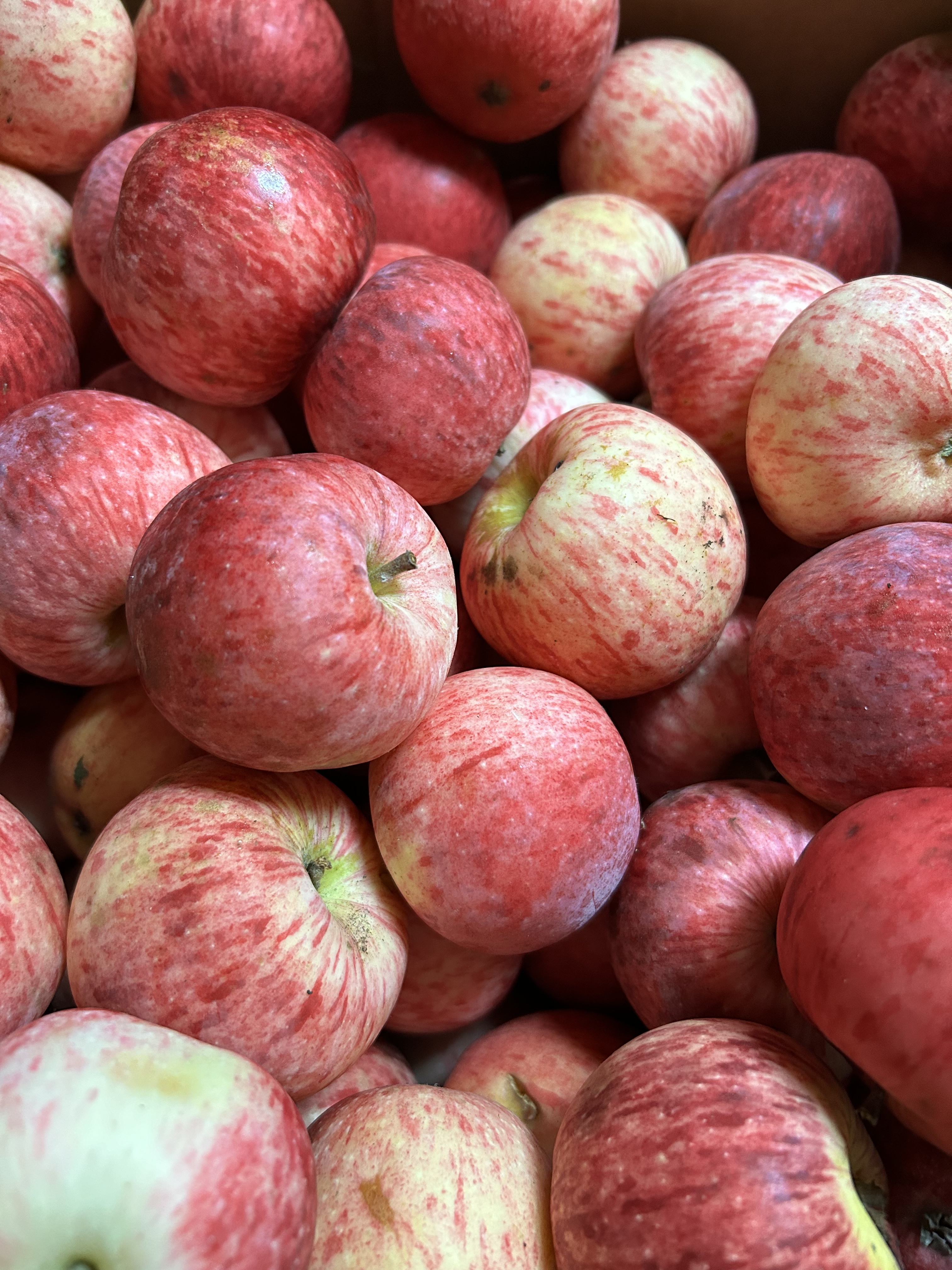
McIntosh apples are medium-sized, roundish to slightly flattened with smooth, thin skin covered with a deep red blush. The firm, crisp, white flesh is juicy, very aromatic and sometimes stained with red streaks. Locally folks mostly use them for making excellent applesauce and for pie making. McIntosh apples are used sparingly in local cider making. The trees bear fruit annually and are very good storage apples. Growing McIntosh apples “off the mountain’ in the piedmont and further south will often produce fruit that does not taste as good. Colder temperatures at our mountain elevation helps us to grow McIntosh apples that match the quality of the original Canadian grown fruit.
#2 WOLF RIVER (also #32)
“U.S. Department of Agriculture Pomological Watercolor Collection. Rare and Special Collections, National Agricultural Library, Beltsville, MD 20705”
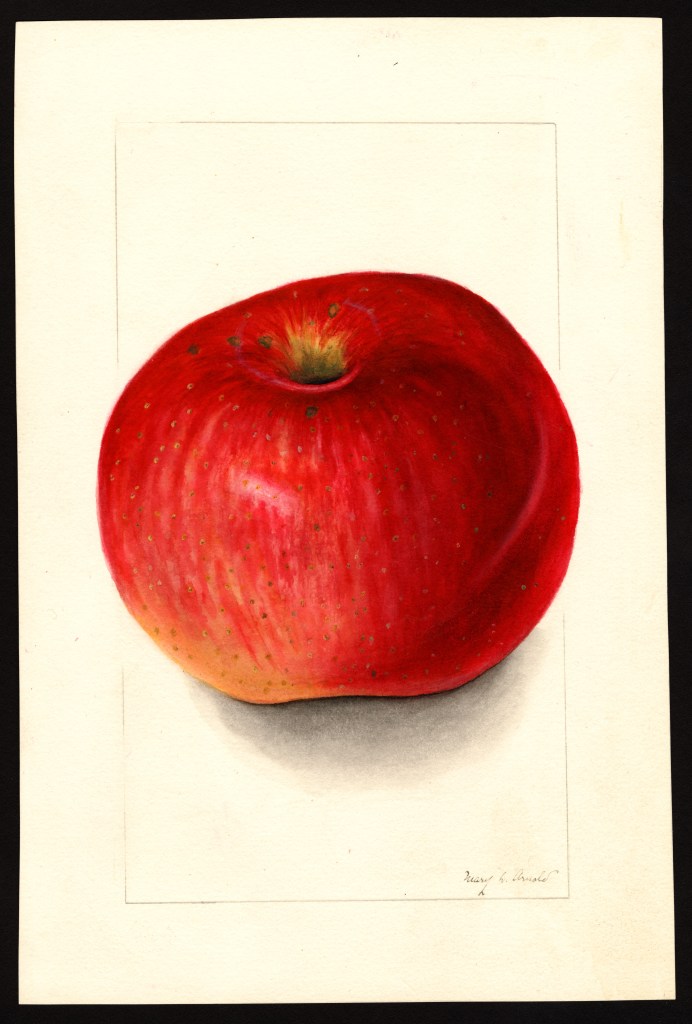
Wolf River – The Crossnore Heritage Orchard has two Wolf River apple trees; Tree #2 & #32. Wolf River apples begin ripening here in mid- September and continue well into October. Older Wolf River trees can be found widespread across Avery County. Many families know them as their “Apple Butter apples”. With widespread, strong limbs they make a landscape tree standout on old farms and in yards. Many trees live well over 100 years old.
The original Wolf River tree was discovered growing on the shores of the Wolf River in Fremont Wisconsin in 1856. This random seedling grew one of the biggest apples to be grown in America. The super large size, oblate shape. and deep red color of Wolf Rivers drew a lot of attention then and still does today.
While the Wolf River is not a great eating apple. However, it is the finest of apple butter apples. It is a clearly a dry apple and cooks down very quickly into a smooth sauce. This “less than juicy” apple lets those making apple butter finish the kettle batches in a shorter amount of time. They make a very smooth and extraordinary applesauce as well. They store well in good condition for several weeks in a cellar or refrigerator. Wolf Rivers have clearly been our favorite apple butter apple in Avery County.
Several people have repeated to us that Wolf River makes a good dried apple too! If you dry some, let us know more.
#3 EARLY HARVEST(also #23 and #28)
“U.S. Department of Agriculture Pomological Watercolor Collection. Rare and Special Collections, National Agricultural Library, Beltsville, MD 20705”
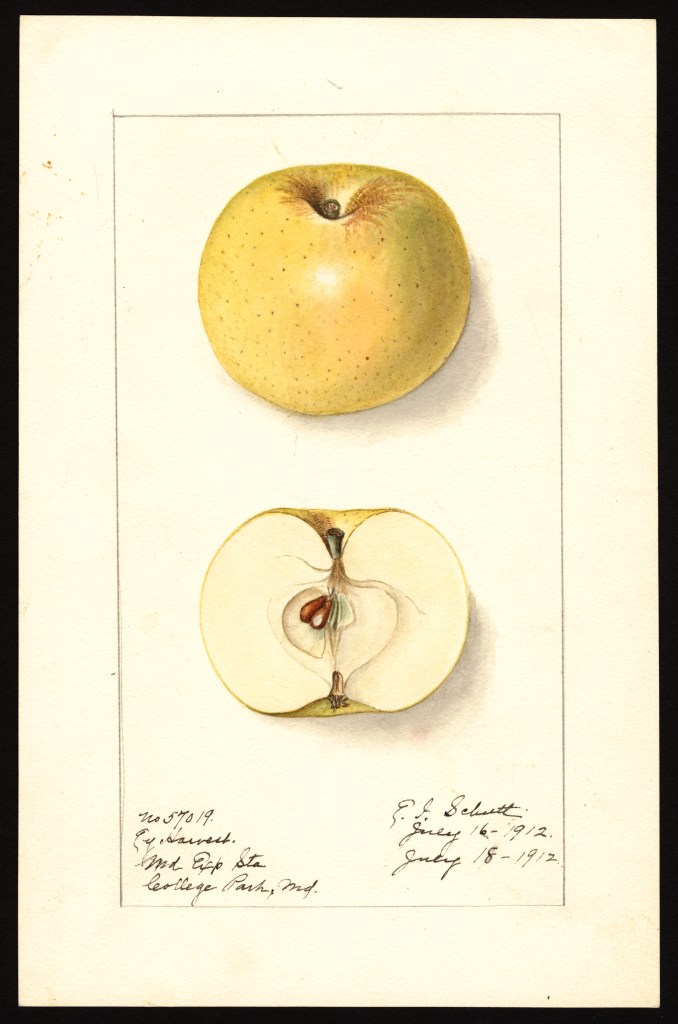
Early Harvest – (also known as Yellow June). We have several Early Harvest trees in the Crossnore Heritage Orchard; Trees #3, #23 and #28. These Early Harvests often begin ripening in mid-late July and continue for only 2-3 weeks. One prominent older Early Harvest tree in Avery County is the old June Burleson family tree hanging over Cow Camp road not far from the intersection with Spanish Oak road.
The Early Harvest, unlike the Yellow Transparent, is a true American original, believed to have been discovered in the early 1700’s on Long Island, New York.
Like the Yellow Transparent, it is easy to grow, with few pest problems. The fruit is medium in size with smooth, yellow skin. The firm white flesh is firm and juicy with a brisk, tart flavor. It is prized for its cooking qualities in making extraordinary applesauce! There are more rare stories about making pies with them in the early summer. Early Harvest trees likely arrived in the North Carolina Mountains with the earliest settlers in the 1700’s.
If you have an established Early Harvest apple tree, Please share with us your story.. We can post them in this website if you wish.
#4 GALA
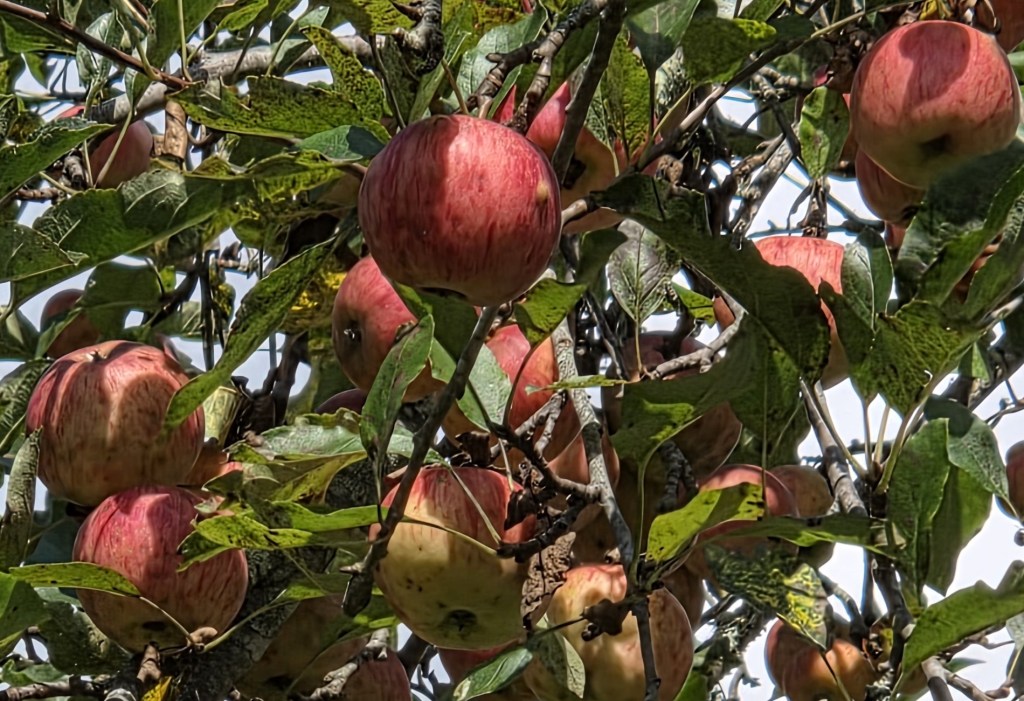
Gala- The Crossnore Heritage Orchard has one Gala apple tree; Tree #4. This apple ripens in September. I don’t know of any truly Older Gala trees in Avery County. Gala apple trees are not a true heirloom apple tree. Gala was the result of modern research in New Zealand in the 1930s and wasn’t released until 1974.
This Gala apple tree sort of snuck into the Crossnore Heritage Orchard by mistake. (-: There are many ‘types’ of Gala apples but this Gala variety seems to be a good one to us. Many Galas are good eating apples, so we are glad to have let this Gala sneak into our heirloom apple orchard.
For more information on the difference between modern and heirloom apple varieties, see the page on this website called ‘What is an Heirloom Apple?’
ent)
#5 STUMP (also #25.5) – from the Crenshaw Orchard
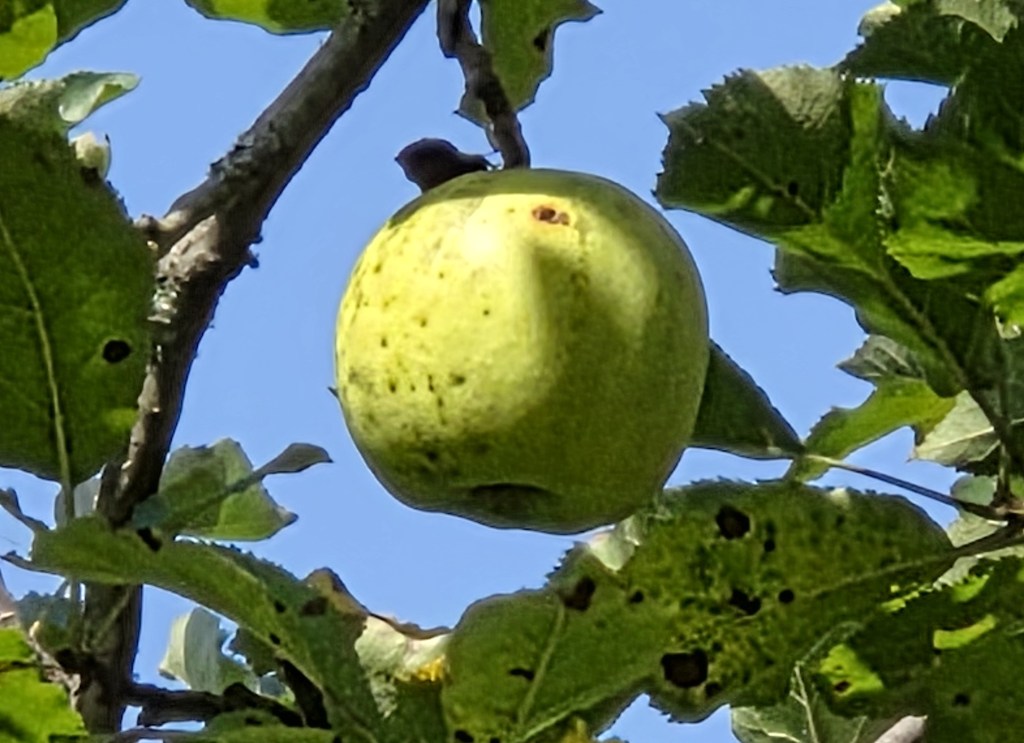
Stump – (also known as Stump of the world) – The Crossnore Heritage Orchard has two Stump apple trees, Tree, #5 and #25.5. This Stump apples begins ripening in late September and continues into October.
This “Stump the World” apple tree comes from the old Gurney Franklin Farm in the Community of Linville Falls. The Franklin / Crenshaw Family have been the preservers of Mr. Gurney’s Farm and his heirloom apple orchard over the years. Jean, Gurney’s daughter, and her children have been very good stewards of this historic farm. Johnny, her son, has helped me for years teaching me about their Stump of the World tree and also a Red Delicious tree Mr. Gurney planted in the late 1930s..
One of many old Southern apples with a confusing name or background. There are at least 3 apples in the Southern Appalachians with at least “Stump” in the name. This “Stump of the World” tree produces fruit that are medium to large size with a very oblate or flatten shape.. They begin fully ripening in early October. A family favorite eating apple, it is fine grained and quite sweet. This Stump of the World apple also keeps well in storage.
This is not the “Fallawater” apple, also called “Stump of the World” by many folks in Avery County. The Fallawater is a different apple, very popular, and also in this Orchard. If you have either of these apples on your property share with us your story about them. We would be happy to post your apple stories on this website, if you wish.
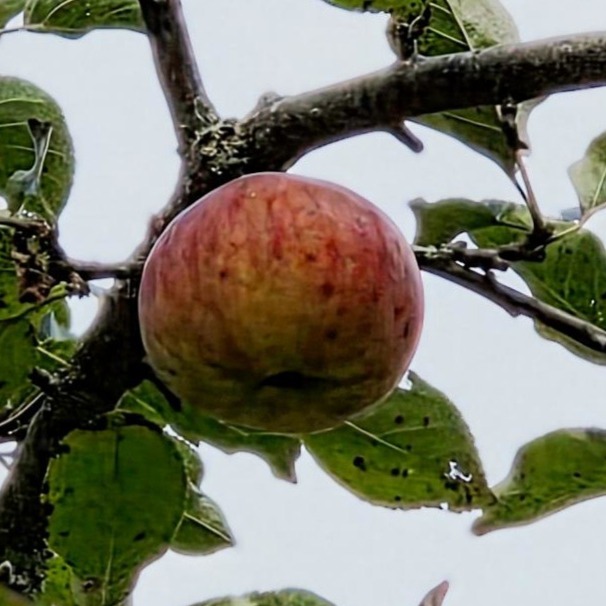
Fall Premium – We have two Fall Premiums in the Crossnore Heritage Orchard, Trees #6 and # 14. They begin ripening in late August. We found our first old Fall Premium apples at Ralph and Ben Baird’s Christmas tree holding area on Old Toe River road. Sometime in the 1960s Ralph had grafted the Fall Premium onto an older apple tree already planted there.
It turned out to be of a more common apple than I thought when I found it up above Crossnore on Dr. Charlie and Ann Baker’s farm. Eventually I found it at other locations too, and realized this apple had been planted and loved by many.
The Fall Premium is a medium to large oblate apple with red striping over a yellow background, when ripe. It is an excellent cooking apple, with a coarse texture and a complex tart/sweet flavor. However, don’t miss the opportunity to bite into a ripe one if you like tart apples. It is strikingly good and enjoyed by manyfor fresh eating!
The tree is a very vigorous grower with few pest problems. It has grown faster than most all the trees in the Crossnore Heritage Orchard. Where does it come from? What is it’s origin. We don’t know because there is not a single listing for the name Fall Premium in any pomological texts! It may have simply lost its original name making the trip to Avery County and here it was given a new name. If you have any notion who might have named this apple, please let us know! If you have any stories on Fall Premium apples, please share them with us . We can post them on this website if you wish.
New Information: The story about the Fall Premium name was my answer for over 25 years. However, in 2024 I sent leaves from the tree to the Fruittree Project at Wasington State University for DNA identification. I received a surprising answer. Our Fall Premiums may be a Red Summer Rambos! I am investigating this now and will update you when I know more.
#7 Newtown Pippin (also #17 and #38)
“U.S. Department of Agriculture Pomological Watercolor Collection. Rare and Special Collections, National Agricultural Library, Beltsville, MD 20705”
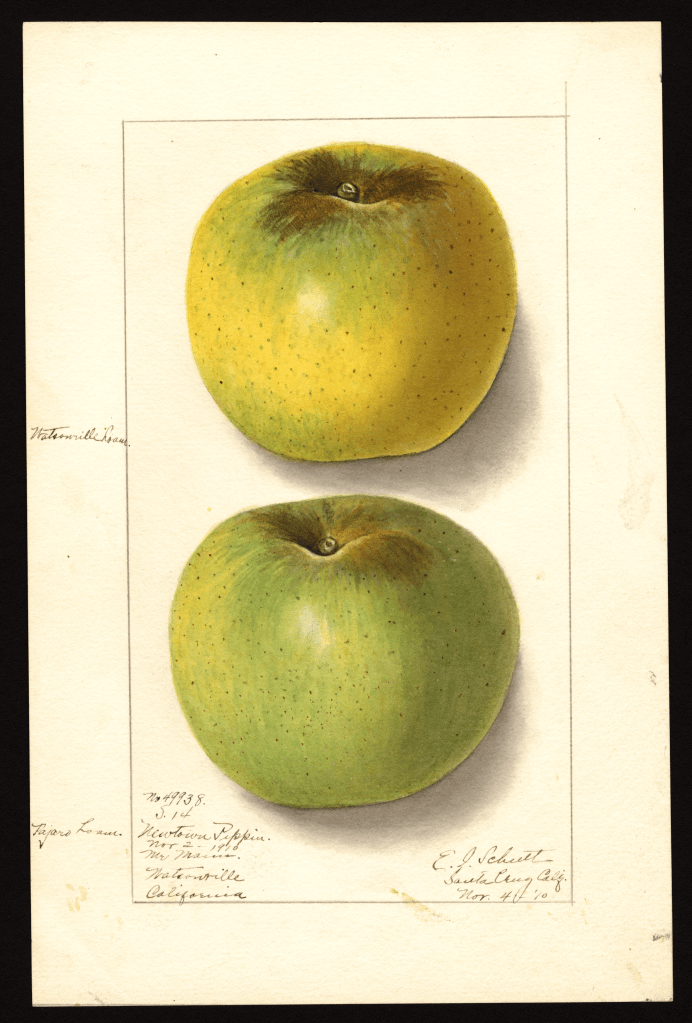
Newtown Pippin– (also known as Albemarle Pippin). The Crossnore Heritage Orchard has three Newtown Pippin trees, tree #7, #17, and #38. The Newtown Pippins are the last apple to ripen each fall in the Crossnore Heritage Orchard. They just begin to ripen at the end of October and continue through November! We don’t believe this variety was very common in Avery County. However it may have been one of the most common apple tree varieties in the United States in the 1700 and 1800s..
The Newtown Pippin is one of the oldest American apples! It was originally a chance seedling in Newtown Village on Long Island, New York in 1665. Its popularity grew rapidly across the Northeastern States at a time when New York State was becoming a source of apple production in the British Colonies. American orchards began shipping Newtown Pippins to England in 1759 due to the work of Benjamin Franklin. After the American Revolution, Newtown Pippins continued to be exported to England.
In 1777 Colonel Thomas Walker and President Thomas Jefferson began growing this old variety in Virginia, changing the name to Albemarle Pippins from Albemarle County Virginia.
The Newtown Pippin is a medium to large, round shaped, greenish yellow apple, showing large dark lenticles as it ripens. It is an outstanding keeper through the winter months, becomes sweeter in storage, reaching its best flavor around Christmas. Used for virtually all purposes, including apple sauce, baking, and cider.
The Newtown Pippins popularity over the centuries continued in home orchards. Do you have a tree? Let us know I may have seen a old one on Ted Farmer’s farm a few years ago!
#8 Grimes Golden (also #31)
“U.S. Department of Agriculture Pomological Watercolor Collection. Rare and Special Collections, National Agricultural Library, Beltsville, MD 20705”
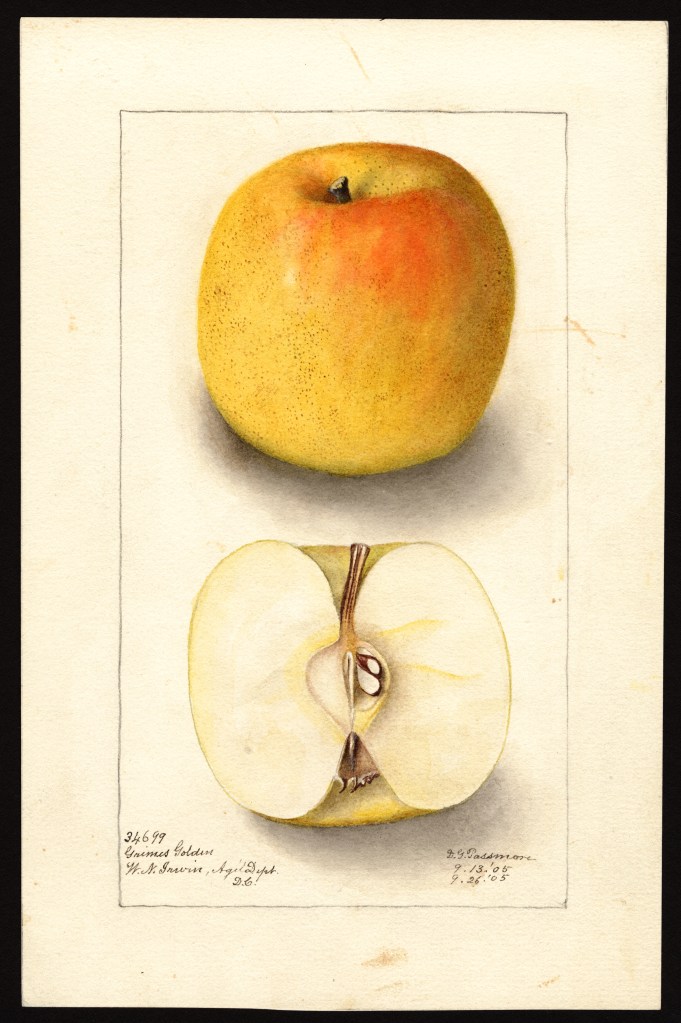
Grimes Golden– (also known as Grimes). We have two Grimes Golden trees in the Crossnore Heritage Orchard, Trees #8 and #31. These Grimes Golden begin to ripen in September each year and continue for atleast a month. We didn’t find a lot of Grimes Golden trees in the orchards of Avery County when we started looking for them.
Since planting Grimes Golden trees in the Crossnore Heritage Orchard we have found a lot of interest in the apple. It is thought to have been a seedling apple planted by Thomas Grimes about 1790 in Brooks County, West Virginia, and now part of Virginia; It quickly gained national attention for cider making, and reported to ferment to 9% alcohol. It is an all-around excellent juicing, eating and cooking apple. It’s a beautiful golden apple with tough skin and scab resistance. It is an early and a reliable bearing apple. It is also believed to be a parent of the Golden Delicious.
If you have a Grimes Golden, please share with us your history. We can post your story on this website if you wish.
#9 Ray Apple – from the Farm of Bill and Edna Vance
“U.S. Department of Agriculture Pomological Watercolor Collection. Rare and Special Collections, National Agricultural Library, Beltsville, MD 20705”
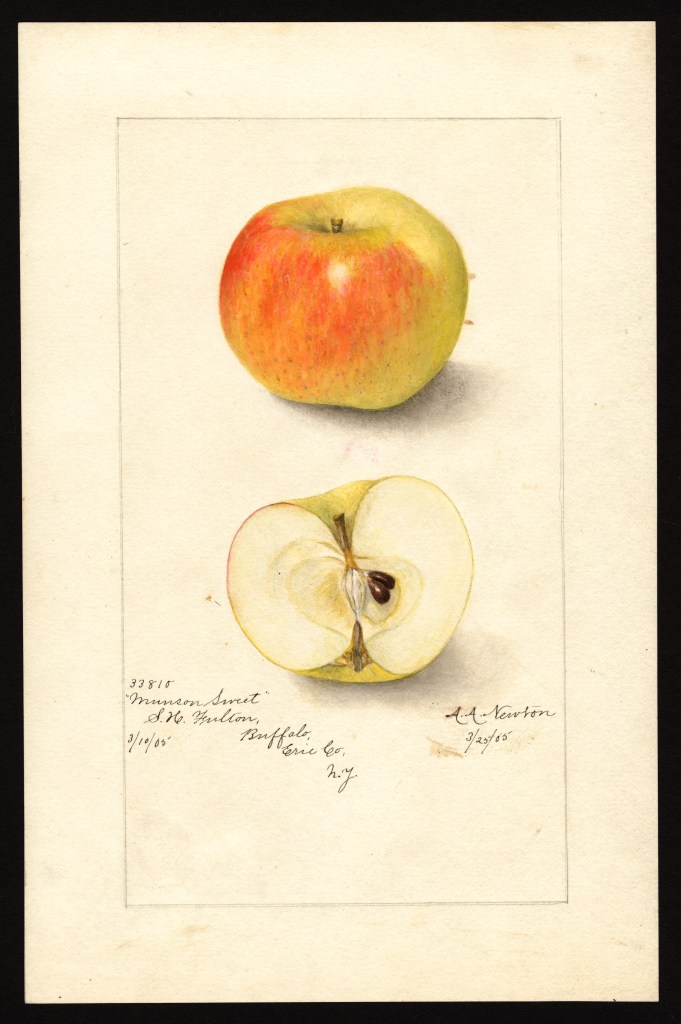
Ray – (also called the Munson Sweet) – The Crossnore Heritage Orchard has one Ray apple, it is Tree #9. The Ray begins ripening very slowly in late September and continues ripening Through all of October. We were lucky to find this Ray apple tree in about 1998. Why? Because according to many, “Stamey Branch used to have many Ray apples all up and down it”. Today it may be there is only this one Ray apple tree remaining in Altamont and it’a located at Bill and Edna Vance’s farm. We could really use you help. Whether you know it as a Ray or something entirely different, please let us know if you think you have this apple.
Billy’s father told him this apple was the Ray Apple. An excellent balance of acidity and sweetness. Edna uses them for all her apple recipes and Billy eats them fresh too. A striking color of orange, red, bronze, & green. We can find the Ray apple in the pomological literature under the name ‘Munson Sweet’; where we find it was discovered in Massachusetts in 1849 as a “fine textured, tender, juicy, and sweet, good quality apple for kitchen use.”
“It is late blooming and fairly early bearing”. What more can we ask!
#10 Hawkeye – Mason and Vida Carpenter
“U.S. Department of Agriculture Pomological Watercolor Collection. Rare and Special Collections, National Agricultural Library, Beltsville, MD 20705”
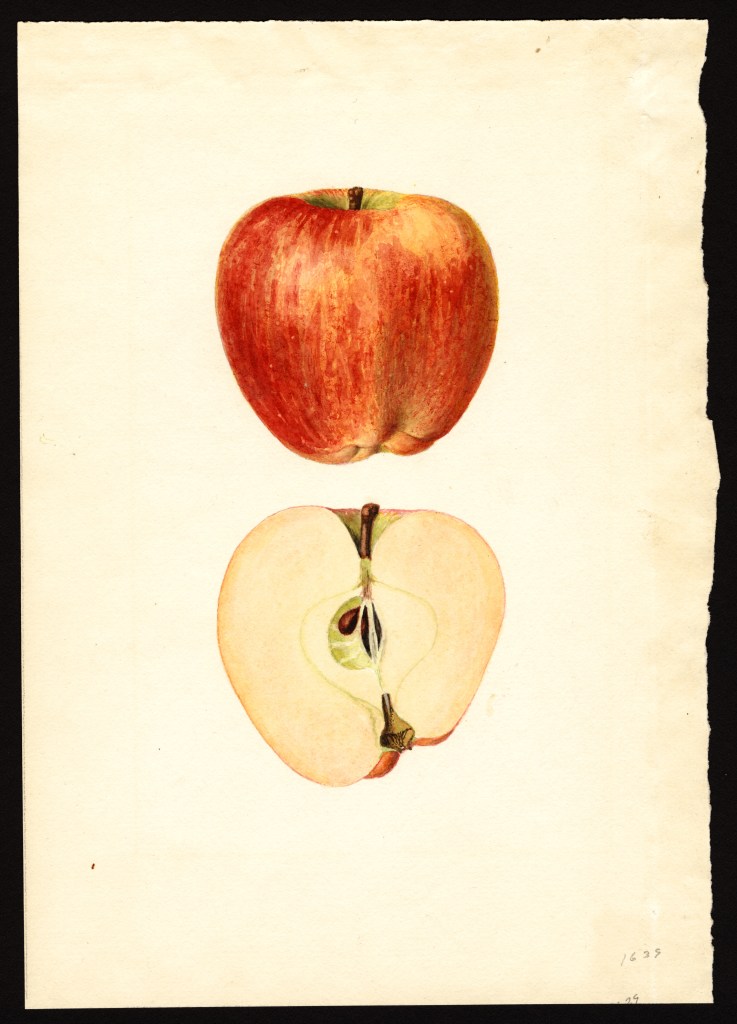
Hawkeye – (also called Red Banana or Red Delicious). In the Crossnore Heritage Orchard this Hawkeye apple is Tree #10. These apples begin ripening in September and may continue into October.
In the Fall of 2005 I was told by Bill Vance about an interesting apple just up Stamey Branch road. I went to meet Mason and Vida Carpenter where they showed me this apple, which they called their Red Banana. I had no idea what it was going to be. It was as a small dull red apple with a conical shape and very sweet. I quickly sent the apple by US mail, to Lee Calhoun, author of Old Southern Apples. He evaluated the apple and felt like it was likely a “Hawkeye” from the early 1900’s. Finding this version of a Hawkeye, later to be called a Red Delicious, here in the Altamont Community was exciting. Here, in our orchard is this same apple, grafted from Mason Carpenter’s tree.
The original Hawkeye apple was discovered in the 1870’s and given the name Hawkeye by its owner and nurseryman Jesse Hiatt in Peru Iowa. 1893 he entered it in a Starks Brothers Apple Fair. Stark Bros. was impressed with its sweet flavor and crisp texture. They offered him a considerable price and he sold the propagation rights to Starks Brothers. They named it a Delicious and later a Red Delicious. Over the years Starks Brothers’ selective breeding for uniform, deep red color and long storage life has resulted in a decline in flavor. Thanks to Mason Carpenter we have what may be an original or early form of the Hawkeye apple in this orchard. See and taste it for yourself!
Note: Later I was shown another “Delicious” apple tree by Johnny Crenshaw, originally planted by his grandfather Gurney Franklin in Linville Falls. Just recently Herbie Johnson showed me a very old Johnson family “Red Banana” tree still producing apples with that excellent Hawkeye flavor.
#11 Summer Banana
“U.S. Department of Agriculture Pomological Watercolor Collection. Rare and Special Collections, National Agricultural Library, Beltsville, MD 20705”
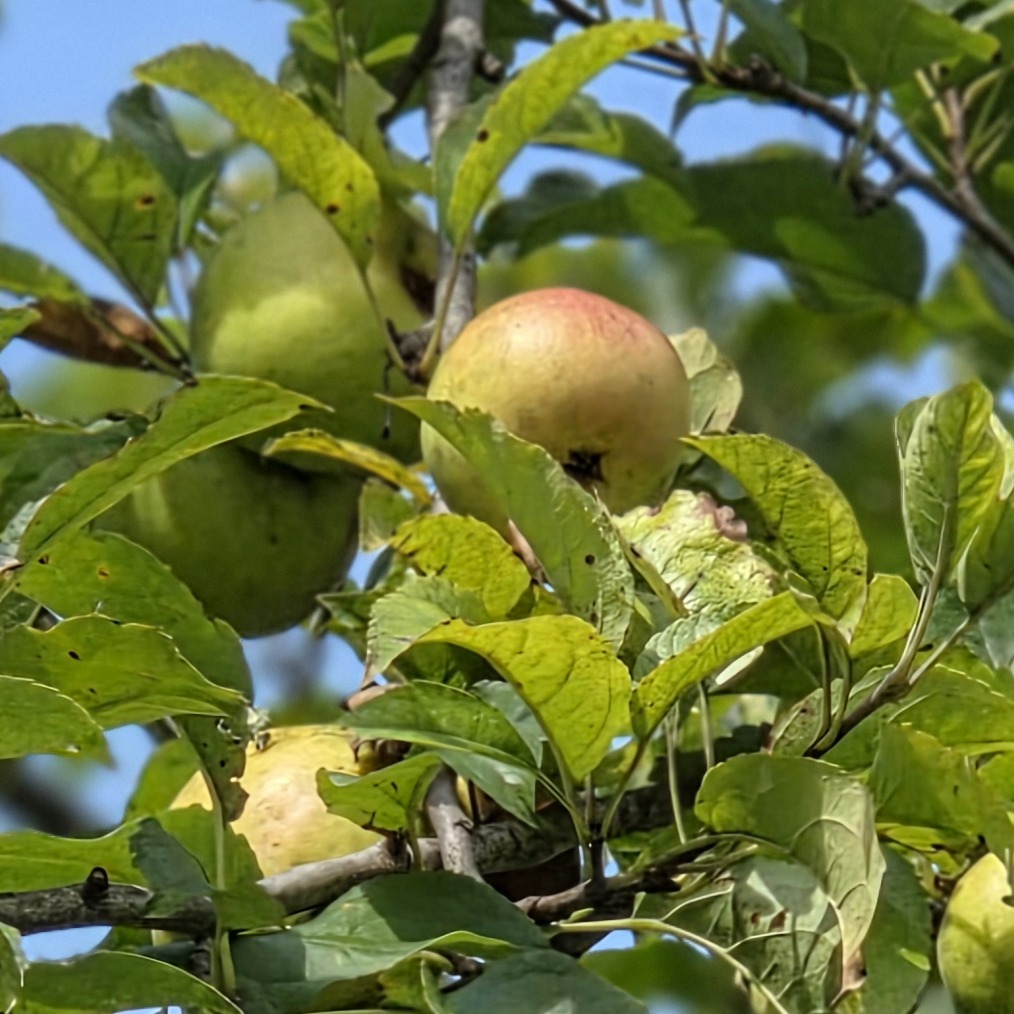
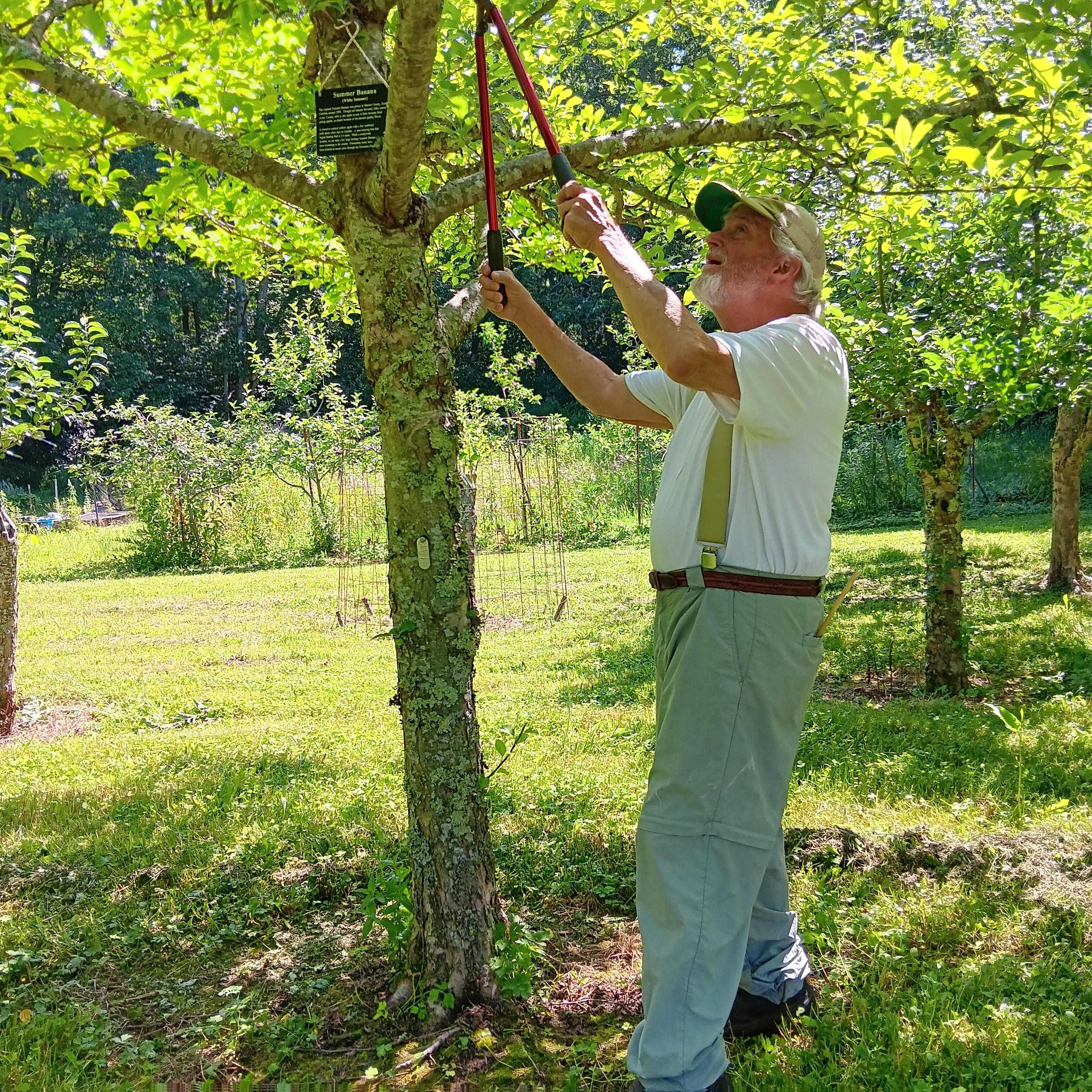
Summer Banana– (Also known as White Summer). In the Crossnore Heritage Orchard this apple is Tree # 11. It begins ripening in late September and continues into October. I have seen a few Older Summer Banana apple trees in Avery County. Perhaps the largest and oldest at Charles and Betty Coles farm in Cole Holler.
The original Summer Banana was discovered in Marion County, South Carolina around 1890. Though not always banana flavored at our elevation, folks across Avery County refer to this apple as one of their favorites, no doubt because of the dessert quality flavor. It tastes and looks much like a Golden Delicious. It’s a round to conical yellow apple with a few scattered pink spots, when ripening in early October. It’s a spur bearing tree and begins bearing fruit in only 3-4 years. It also stores very well into the winter months. We see only a few large heritage trees remaining in Avery County. Fortunately many have been replanted in recent years through the Avery Extension Plant Sale. Please share with us your stories, if you have an older Summer Banana tree. We can post them on this website if you wish.
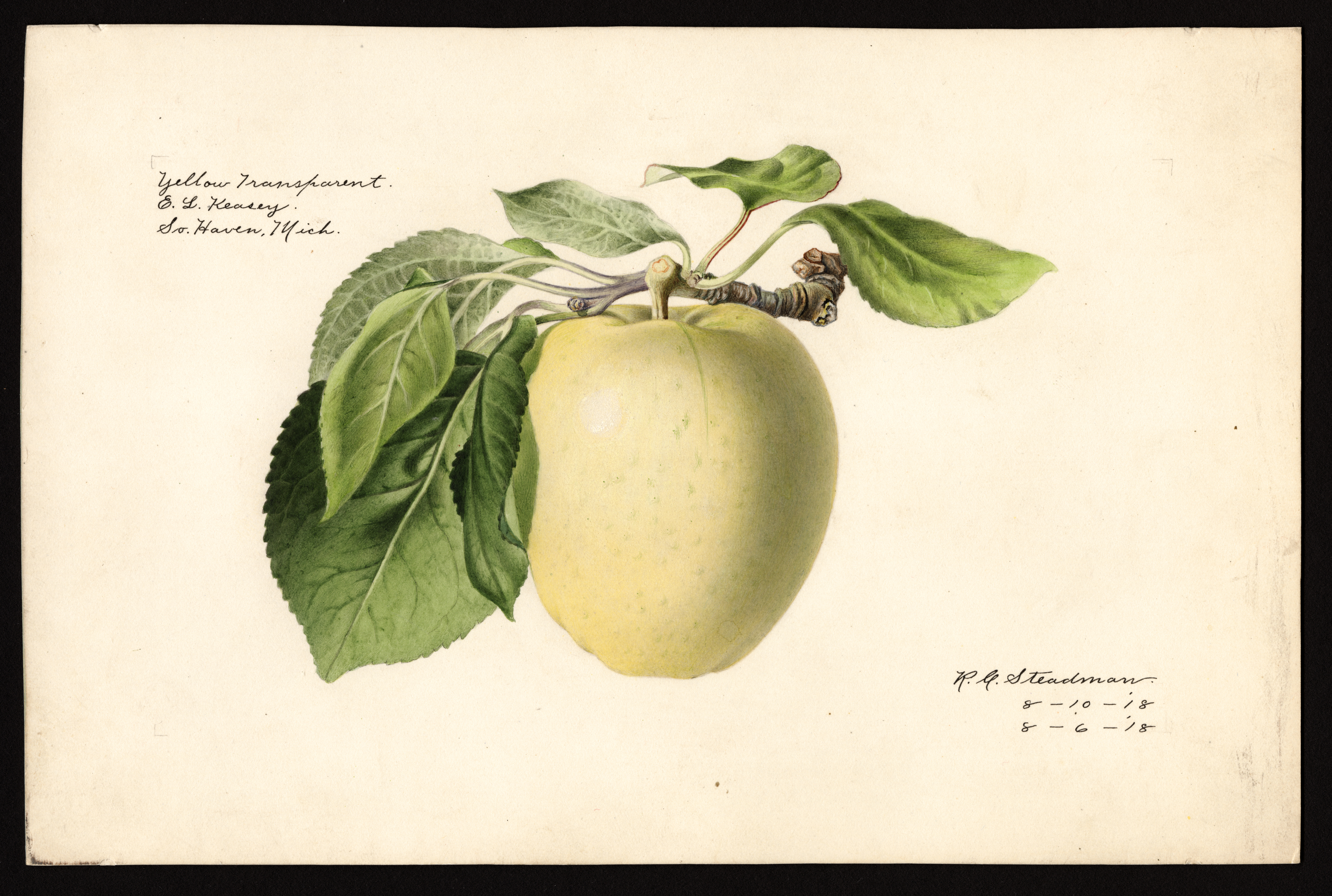
#12 Yellow Transparent
“U.S. Department of Agriculture Pomological Watercolor Collection. Rare and Special Collections, National Agricultural Library, Beltsville, MD 20705”
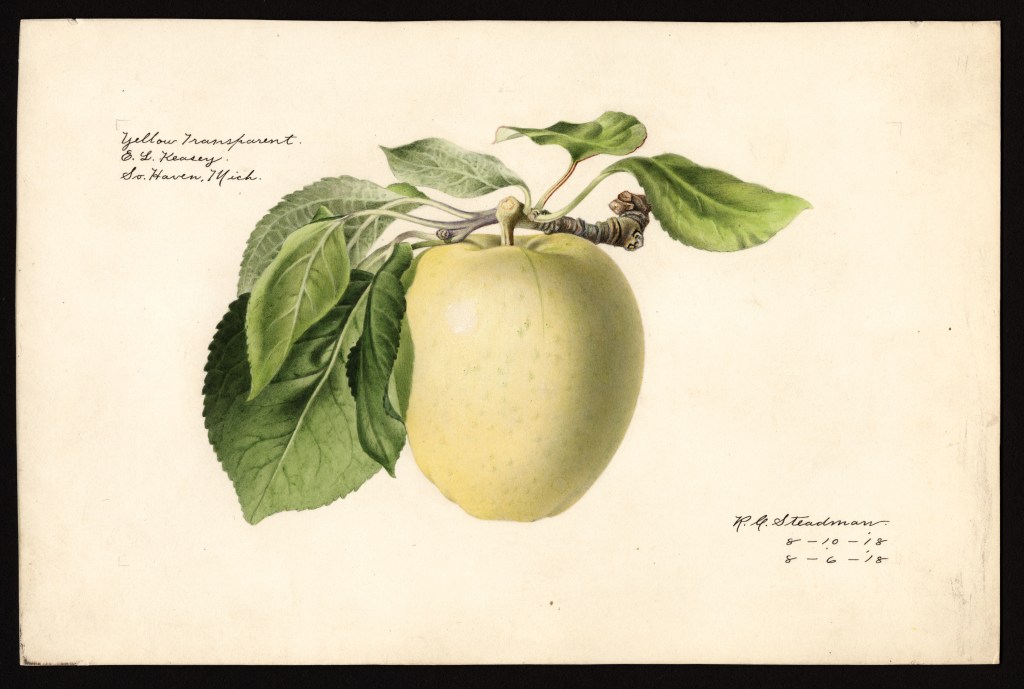
Yellow Transparent – (also known as Early Transparent or June apple).
The Yellow Transparent is Tree #12, and it begins ripening in early-July in the Crossnore Heritage Orchard. Older Transparent trees, can be found all over Avery County. Gleason Harmon had a nice old Transparent tree beside his home in Crossnore. Boots Burleson still harvests apples from the Transparent tree that June and her originally grafted at their home on Spanish Oak.
However, probably the oldest Transparent I’ve seen was at Dovie and Lum Stamey’s place on Stamey Branch (also known as Horney road.)
Yellow Transparent was one of several old Southern apples which originally came from Russia and brought here by the United States Department of Agriculture in 1870. “Transparents” were brought here because they could be grown in many areas of the South, despite the warmer temperatures. Fortunately they grow well here in the mountains too. The fruit is small to medium size with smooth transparent yellow skin. It has tender white, fine grained flesh and very juicy. Its bright tart flavor makes it a great applesauce apple. Many local folks consider it the best apple for making “Fruit”; our word for “Applesauce”! Please share with us your stories, if you have some on your Transparent apples. We can post them on this website if you wish.
#13 Carolina Red June (Also #35)
“U.S. Department of Agriculture Pomological Watercolor Collection. Rare and Special Collections, National Agricultural Library, Beltsville, MD 20705”
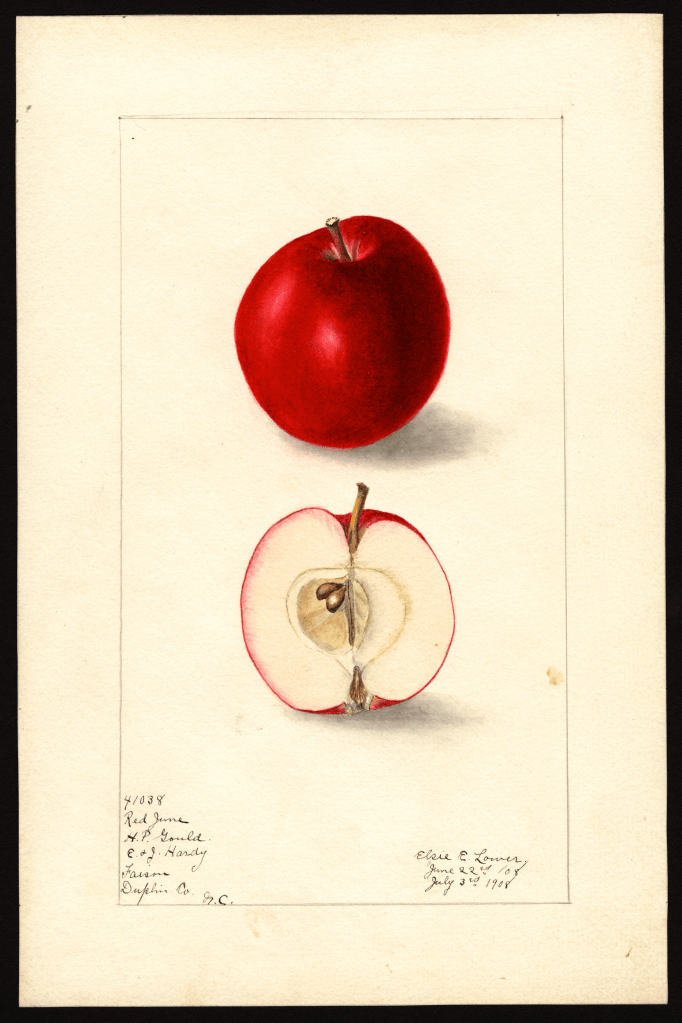
Carolina Red June – (also known as Red June, Red Juneating, and Georgia June). We have two Red Junes located in the Crossnore Heritage Orchard, Trees #13 and #35. Our Red Junes begin ripening in mid-July and continue for a few weeks. I saw my first Carolina Red June tree at Ernest Harmon’s farm in the Flat Springs community.
The Carolina Red June is a longtime Southern favorite, and believed to have originated before 1800 in Tennessee. Fruit is small to medium with smooth, solid dark red skin and somewhat oblong in shape. The juicy fine-grained flesh is white and sometimes stained red when ripe. This early apple has an distinct high quality flavor and texture, making it a first choice for apple sauce, early summer pie making and even fresh eating. Very few older Carolina Red June trees remain in our area. They may be short lived and they don’t become large trees. However new Carolina Red June trees are sold by the Avery Extension Plant Sale and have been planted for years now. Please share with us if you have some Carolina Red Junes. They are apples with a rich Southern heritage.
#14 Fall Premium (Baird Farm) see # 6
#15 Golden Sweet
“U.S. Department of Agriculture Pomological Watercolor Collection. Rare and Special Collections, National Agricultural Library, Beltsville, MD 20705”
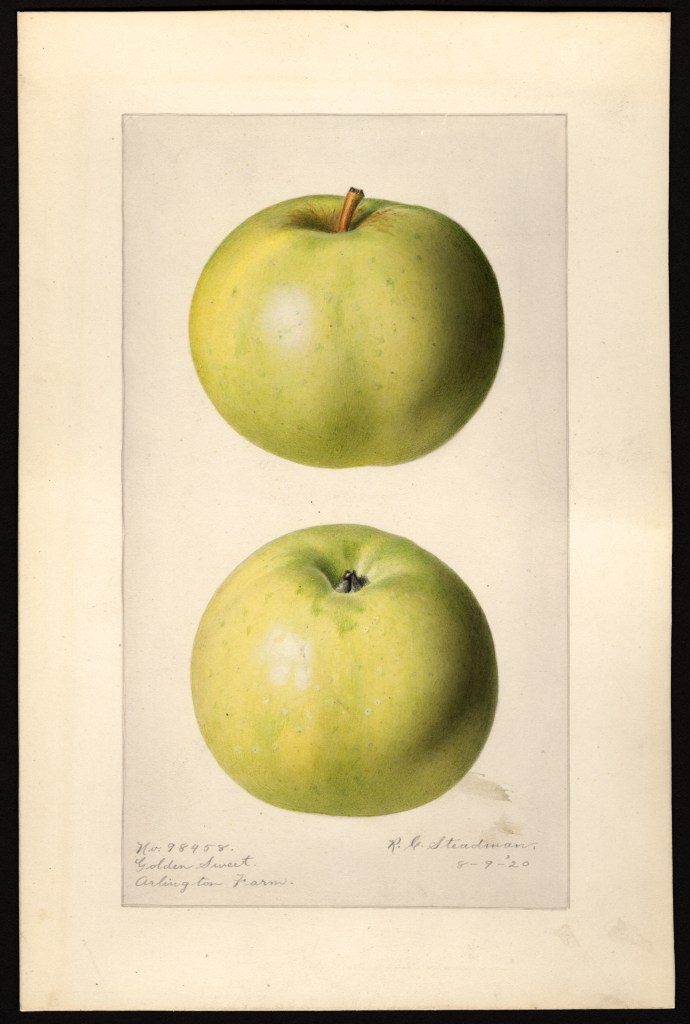
Golden Sweet – (also known as Golden Sweeting, Early Golden Sweet). We have one Golden Sweet apple tree in the Crossnore Heritage Orchard, Tree #15. This apple tree begins ripening in early August. We have found only a few older Golden Sweet trees in Avery County.
Unlike most early apples the Golden Sweet is an extraordinarily sweet apple; So sweet that the first bite can be a bit of a shock. It has no acid to balance the sweetness. It originated in Connecticut, but details of its origin are unknown. Golden Sweet was once quite popular and sold widely by Southern nurseries. Fruit is medium size with thin, smooth waxy yellow skin. This apple has limited uses other than fresh eating and is a favorite of children!
#16 Bevins Favorite (Also #25)
“U.S. Department of Agriculture Pomological Watercolor Collection. Rare and Special Collections, National Agricultural Library, Beltsville, MD 20705”
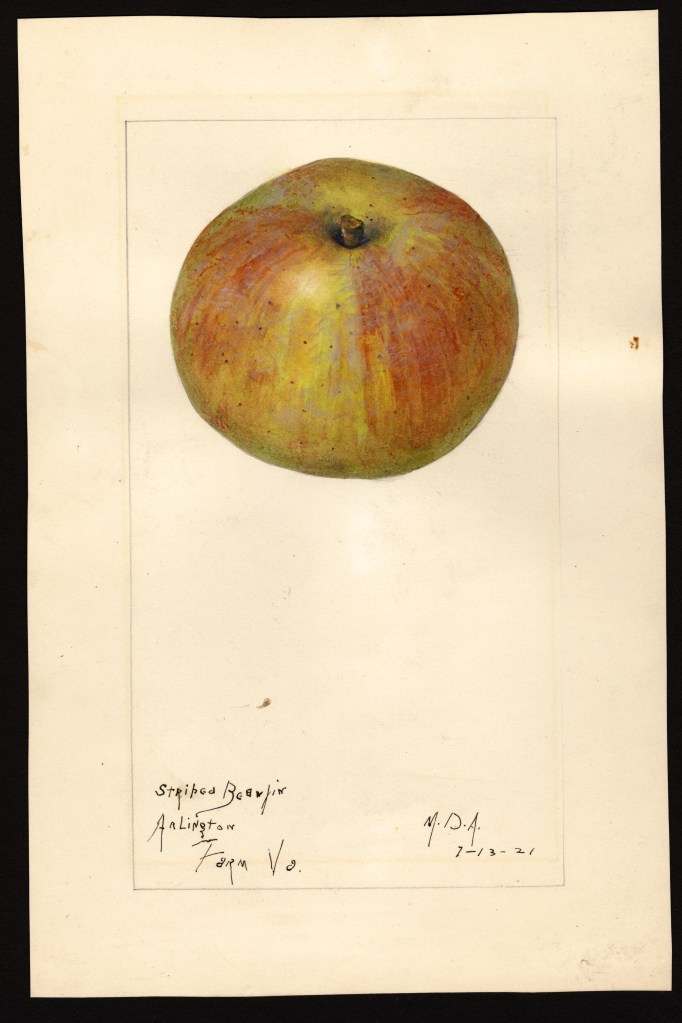
Bevins’ Favorite – (Also known as Striped June, Early Bevan, Bivins). The Crossnore Heritage Orchard has two Bevin’s Favorite Apple, Trees #16 and #25. The apples begin ripening in late July, then continue into early August. The Bevin’s Favorite found its way into our orchard by way of David Vernon and the Century Farm Orchards. We ordered this tree because we wanted to have one of our local apples called the ‘Striped June’. It turned out the Bevin’s Favorite wasn’t our local Striped June. Neither David nor I knew it wasn’t the same. I personally have not seen this apple in Avery County other than here in this orchard. However, if anyone has seen an Older Bevin’s Favorite tree, please let us know.
The Bevin’s Favorite is a known Southern apple and was common in the Piedmont of North Carolina. However, the Bevin’s Favorite originated in Salem, New Jersey during the first half of the 1800s. Lee Calhoun, author of ‘Old Southern Apples’ undertook the search of this cultivar and discovered a lone tree in 1985 in Alamance County. It was noted in several pomological books in the 1800s as a Southern Apple.
The Bevin’s Favorite is a small to medium size apple with a round to flattened shape, greenish yellow, with wide, bright-red stripes on the sun exposed side. The flesh is white, crisp, fine grained and moderately juicy with a sweet/tart flavor. For many years it has been used for fresh eating, baking, and frying. History tells us to use it shortly after picking, as it does not store well.
#17 Newtown Pippin (see # 7)
#18 Virginia Beauty (Theron Dellinger) (see also #20)
“U.S. Department of Agriculture Pomological Watercolor Collection. Rare and Special Collections, National Agricultural Library, Beltsville, MD 20705”

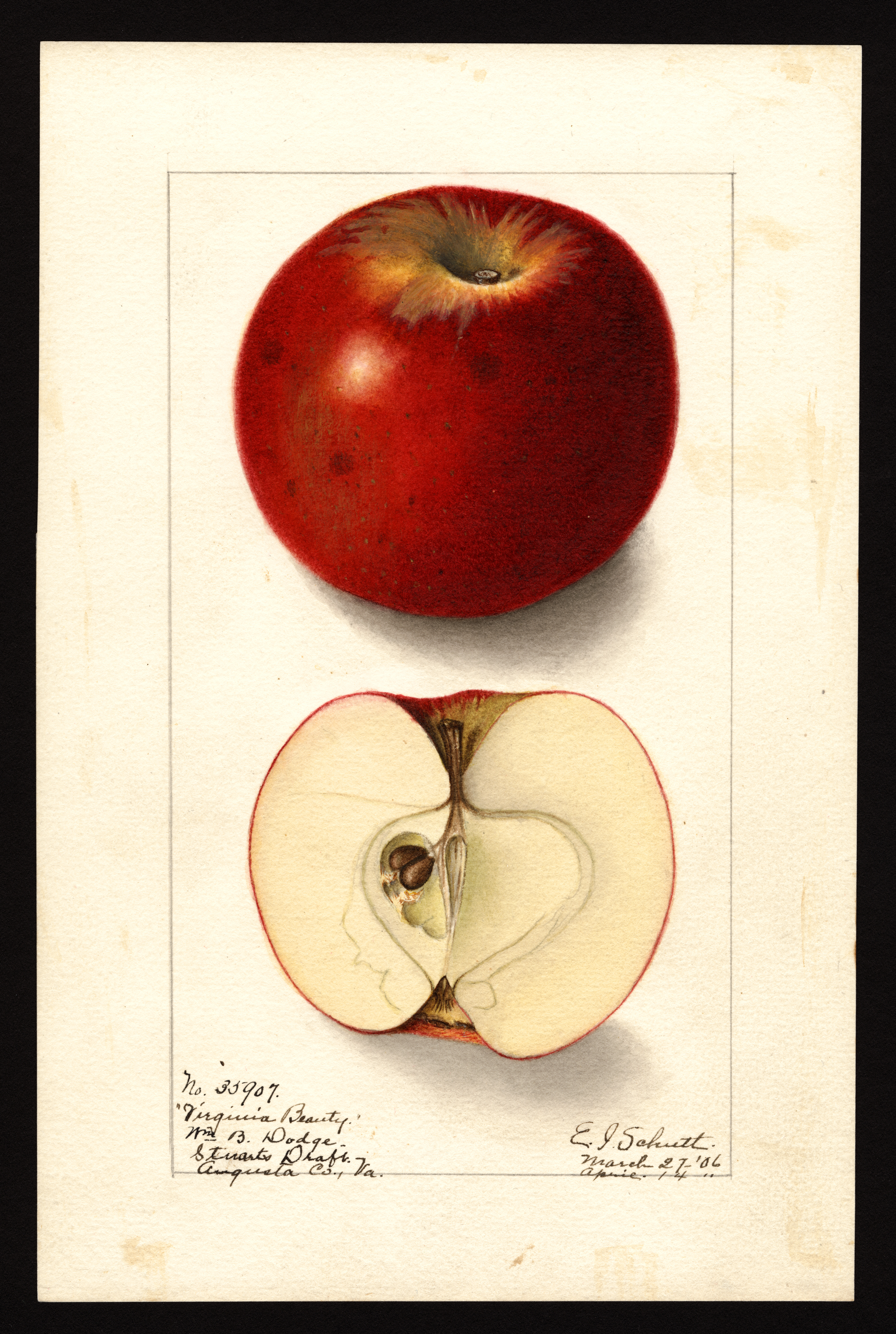
Virginia Beauty – (Also known as Zach’s Red). The Crossnore Heritage Orchard has two Virginia Beauty apple trees, #18 & #20. These apples begin ripening in late September and continue into October. The Virginia Beauty tree #18 was grafted from the last Virginia Beauty tree in the Theron Dellinger Orchard in Crossnore, after it fell to the ground during a March windstorm several years ago. Virginia Beauties have been perhaps the most loved apple in Avery County for many years. Old heritage Virginia Beauty apple trees remain standing across Avery County in many communities.
The Virginia Beauty tree #20 came from the Century Farms Orchard in Reidsville, NC. Century Farms is the primary supplier in the North Carolina for heirloom apple trees.
The original Virginia Beauty was discovered by Zach Safe wright around 1820 in Carrol County Virginia. It was grafted and grown throughout Southwest Virginia under the name Zach’s Red.
It acquired its new name from the Franklin Davis Nursery in 1869. From Virginia, it has been planted across the United States under this new name.
It is a medium size apple with deep solid red color and a sweet eating flavor all its own. It is usually picked in early October and carefully stored for fresh eating throughout the holiday season. Not often used for cooking or drying, it is an excellent dessert apple with an extraordinary floral aroma.
Recently some of us have found it keeps it’s shape well in pies and when juiced they produce an excellent sweet cider flavor. Tell us about your Virginia Beauty apples.
#19. Sheepnose (Banner Orchard)
“U.S. Department of Agriculture Pomological Watercolor Collection. Rare and Special Collections, National Agricultural Library, Beltsville, MD 20705”
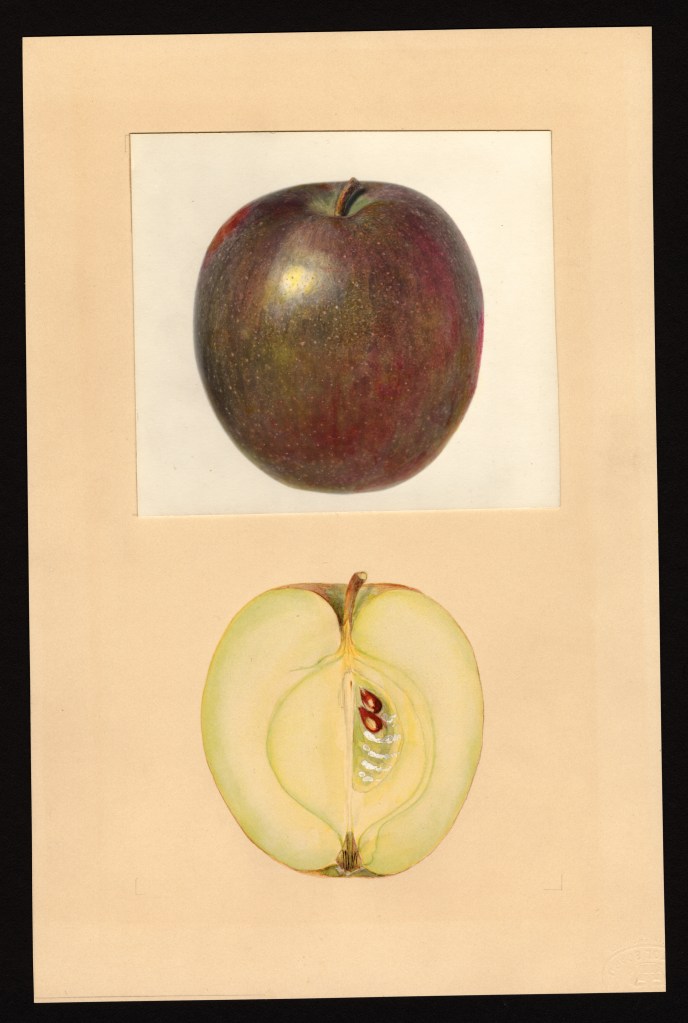
Sheepnose – (also known as Crow Egg, Banana apple, Black Gilliflower). The Crossnore Heritage Orchard now has one fairly new Sheepnose apple, Tree #19. The Sheepnose apples begin ripening in late September. Older Sheepnose trees are scattered across Avery County. The orchard source for the Sheepnose tree in this orchard comes from the Gary Banner Orchard near Luther Rock.
The long list of names above, for the Sheepnose apple, can all be heard within Avery County. The most common thing I hear about the Sheepnose is, “it’s our children’s favorite apple.” Please share with us your stories, if you have some on the Sheepnore. We can share them on this website if you wish.
A funny looking, highly oblong apple, it can hardly stand up on its pointed sheepnose base. Beginning green, the young apples turn to a dull reddish green color as it begins ripening. The amazing thing is they are fully ripe, they taste to me, alot like a sweet ripe banana!
If you can wait for them to fully ripen, and quickly store them in a refrigerator, they will taste sweet for weeks! They are very good keepers too, as long as you don’t let them get overripe before using or storing them. Shortly after peak ripeness they become rather dry and mealy.
A great fresh eating apple. Boots and Junior Burleson grafted two of the finest Sheepnose trees I know!
“U.S. Department of Agriculture Pomological Watercolor Collection. Rare and Special Collections, National Agricultural Library, Beltsville, MD 20705”
#20 Virginia Beauty See #18
#21 Summer Rambo (Crossnore Post Office)
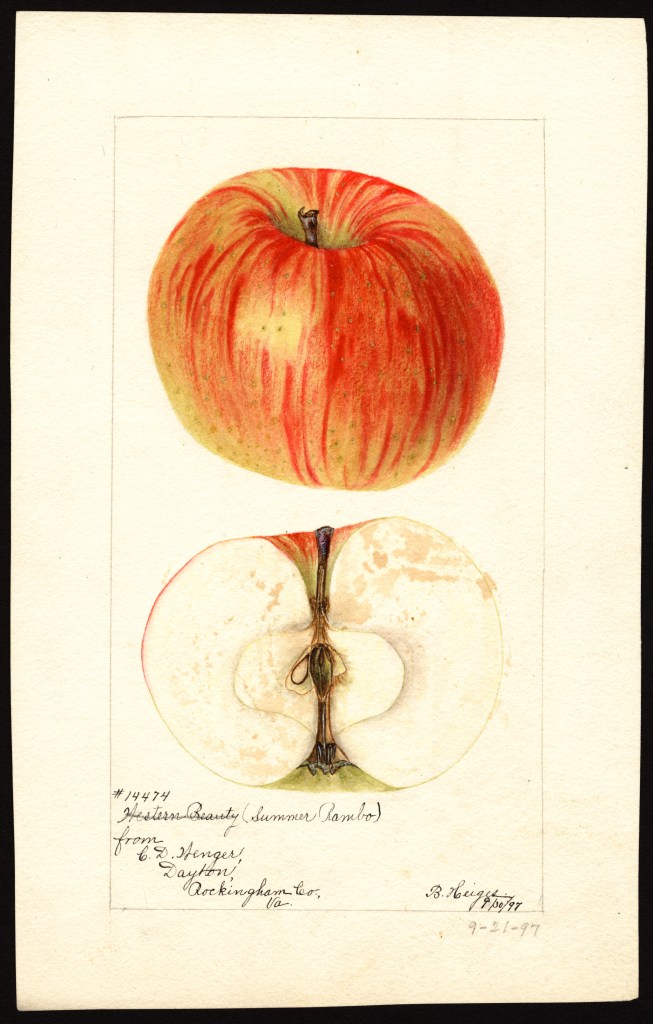
Summer Rambo – (Franc Rambour, Rambour d’ete). The Crossnore Heritage Orchard has one Summer Rambo Tree, #21. These apples begin ripening in early August and finish in early September, About 15 years ago Gleason Harman, a volunteer and my dear friend in the early years of the Crossnore Heritage Orchard wanted to show me his favorite apple. He took me to an apple tree across the road from the Post Office. Neither he nor I knew what kind of apple it was at the time. Then he showed me the same apple on a tree at Clay Moore’s house, and another next to the Crossnore Volunteer Fire Department building behind the Baptist church.
I too liked the apple so much that I started asking around and no one seemed to know what it was called. I gathered scionwood cuttings from the tree across from the Post Office, grafted a dozen plus trees, and 3 years later sold them in the Avery Extension Plant Sale. Since I didn’t know what it was, I simply called it the “All Over Crossnore” apple. I told this story at that time and they sold like hotcakes!
Soon afterward I found a picture and description of the Summer Rambo apple and recognized it immediately. About the same time someone, I can’t remember who, told me the stories of Crossnore resident Milligan Wise. Milligan’s horticultural reputation was renowned in Crossnore. He had helped many of his friends and neighbors plant their properties with fruit trees and bushes of all kinds. We are quite confident that he was the source of the Summer Rambo trees. Thank you again Mr. Wise.
Once we knew what the apple tree was we read more about it’s remarkable history.
Summer Rambo was one of the first apple trees shipped to the Americas in the middle 1700’s by founding fathers, like Jefferson and Washington. The Summer Rambo is a French apple discovered in the village of Rembure, France in 1548. It was such a remarkable apple it was imported to America very early and grown in home orchards across the United States ever since. You can do the math! (-:
My favorite Old Summer Rambo apple tree was a giant 100+ year old tree in Banner Elk, located on highway 184, beside the Old Banner House’. I trust some of you saw that giant apple tree beside this famous house.
About 2009, I was visiting with Ms. Mary Elder, she was 105 years old at the time. She told me, “when I was just a child I remember picking apples under that tree.” I too picked up apples off the ground under that tree for a few years, just to check on the tree. I understand this tree was cut down last winter, 2024/25. I hope Helene caused it’s demise.
Unfortunately the Summer Rambo Apple Tree that stood across from the Post Office was blown down by Hurricane Helene in late September. A numbers of folks have told me they had‘picked up the apples from under that tree for many years.
About 12 years ago I took cuttings from the same “Post Office” tree and grafted, grew, and planted the Summer Rambo in Crossnore Heritage Orchard. We hope this new Summer Rambo tree will be secure for the future. This tree just started bearing apples in the last year.
Note: This Spring 2025, the Avery Extension Plant Sale will be selling Summer Rambo, American Golden Russet, and Sheepnose apple trees!
#22 Fallawater
“U.S. Department of Agriculture Pomological Watercolor Collection. Rare and Special Collections, National Agricultural Library, Beltsville, MD 20705”
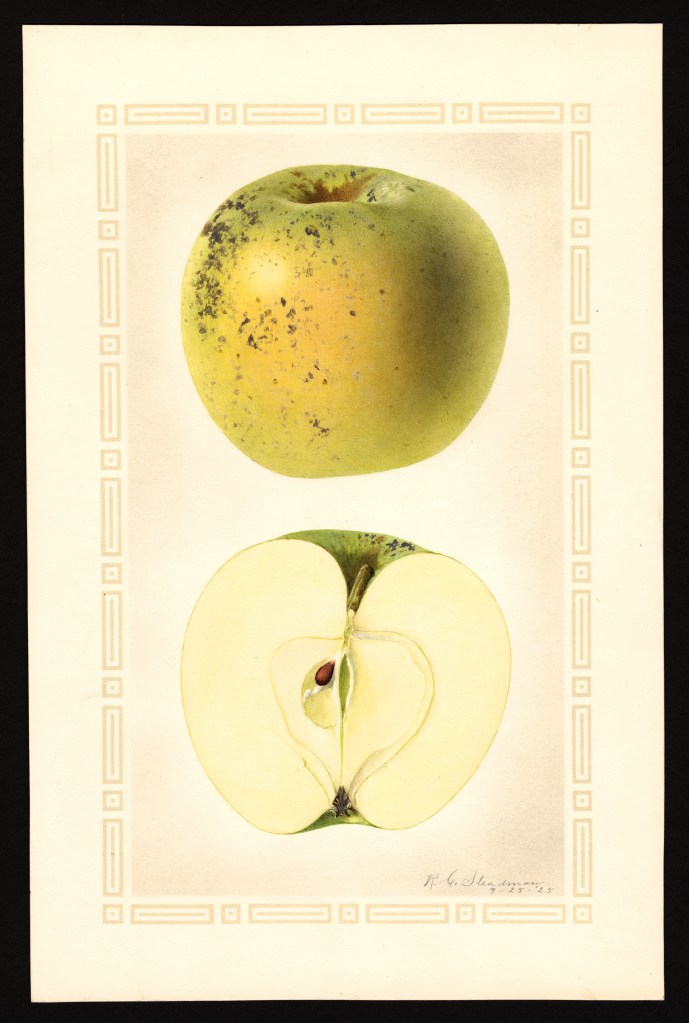
Fallawater – (also known as the Stump of the World). There is one Fallawater apple tree in the Crossnore Heritage Orchard, Tree #22. It begins ripening in early September and continues slowly ripening into October. There were several older Fallawater apple trees around Crossnore. I saw and tasted my first Fallawater apple at Jack Wiseman Sr’s. tree in Altamont, what a treat! One of the oldest Fallawater trees left may be Clay Hartley’s tree not far off Mount Pleasant road, on the Johnson Holler road. Please share with us your stories, if you have a Fallawater. We can post your story on this website if you wish.
The Fallawater apple trees, often called Stump of the World’s in Avery County may have been one of the most common apple trees here. It is a quite large, round shaped apple. It is colored green when growing, and then turns yellow and gold, then some bronzing blush on the sunny side as it fully ripens. The flesh is tender and quite juicy with a mild sweet flavor. Fresh eating may be its favorite use. but cooking and apple sauce were common too. It stores OK but not far past Christmas. The original Fallawater apples, the story goes, were found in 1842 floating downstream in the Tulpenhocken creek in Pennsylvania.
There is a second, similar tree in Avery County called a Flat Fallawater. It has similar coloring, is a little smaller, and has a more oblate shape. It is a good tasting apple too, ripens in October, and stores very well into the winter. We do not currently have a Flat Fallawater in the orchard.
#24 Dula Beauty
“U.S. Department of Agriculture Pomological Watercolor Collection. Rare and Special Collections, National Agricultural Library, Beltsville, MD 20705”
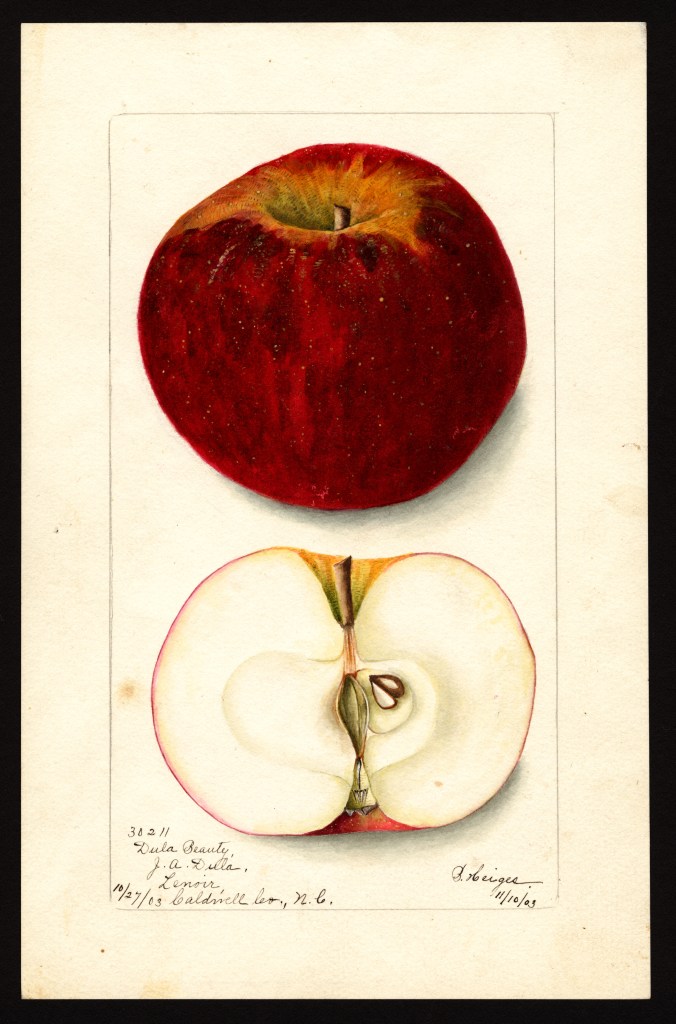
Dula Beauty – (Also known as Dula). The Crossnore Heritage Orchard has one Dula Beauty, Tree, #24. In our area the apples ripen in October and may continue ripening into November. I have only seen two Older Dula Beauty Trees, both in Jonas Ridge in the Orchards of Ernest and Lonnie Barrier. Both were true gentlemen and friends in the 1970 & 80s. Ernest was a very close friend of mine and first sparked my interest in heirloom apples. Ernest explained to me that Dulas were his family’s favorite apple and that they were good for fresh eating and baking and kept all winter in their cellar! The Coffey Grounds Orchard in Watauga County also has some very old Dula Beauty trees. Please share with us your stories about the Dula Beauty if you have some. We can post them on this website if you wish.
The Dual’s Beauty originated in Lenoir North Carolina, from Limbertwig seeds which Mr. J.A. Dula planted for grafting. The resulting apple turned out to be a good dessert quality apple. The tree is vigorous, a prolific bearer, and is said to grow well on either bottomland or on hillsides.
Fruit is large, oblate, and slightly conical; skin almost entirely covered with dark red and obscure darker stripes. The flesh is yellowish white, tender, crisp, juicy, mild sub acid. Our one and only Dula Beauty tree has only just begun bearing apples in 2024 at 14 year’s old. Please show care, we are just now having the opportunity to study this apple. Thank you
#25 Bevins Favorite (see #16)
#26 Rambo (Stamey Orchard)
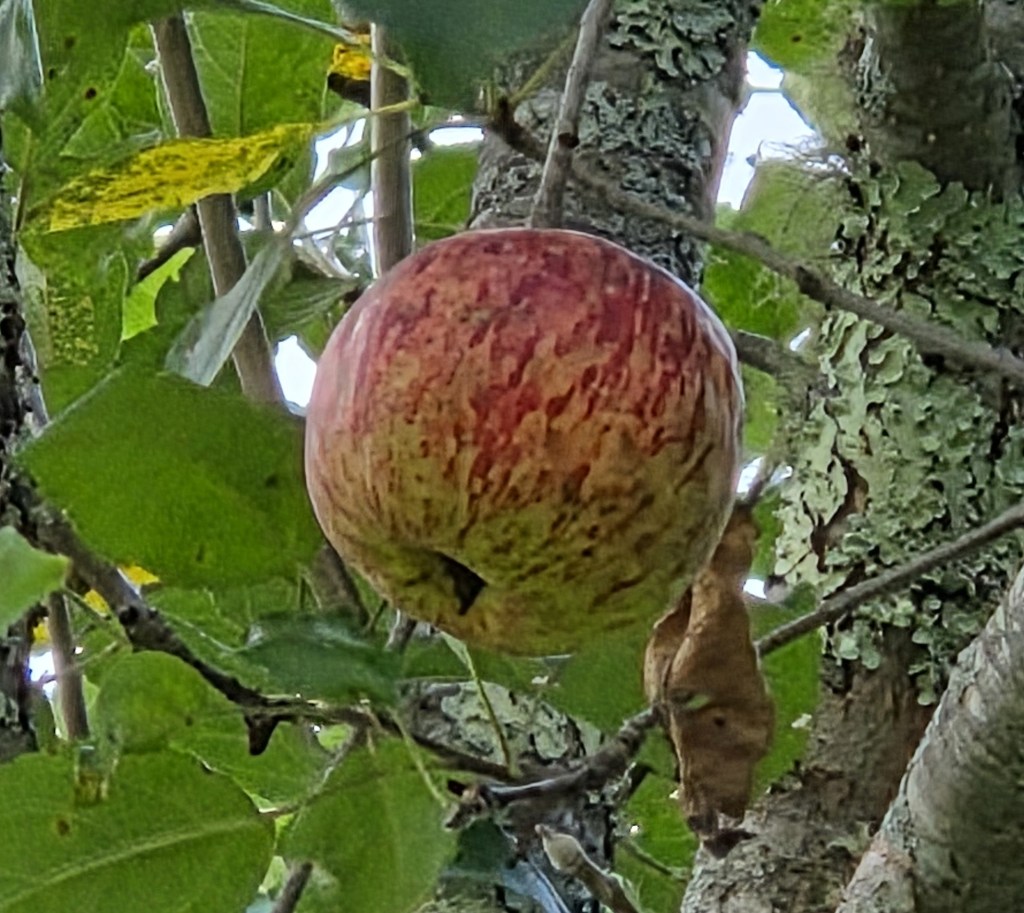
Rambo– (Winter Rambo, American Seek No Further). We have one Rambo tree in the Crossnore Orchard, Tree #26. We think the Rambo begins ripening in September. The first Older Rambo apple tree we found was in the orchard of Dovie Stamey. The tree was positioned near the house of Jean Hoffer, Dovie’s daughter. This house was located on Stamey Branch or Horney Rd., depending on who you are talking to. (-: Mrs. Hoffer welcomed me to take cuttings and some fruit to study.
The Rambo apple needs to be distinguished from the Summer Rambo. Unlike the Summer Rambo, which is a French apple, the Rambo is a true American Heirloom apple. According to Coxe, author of The Apples of New York in 1817, it took its name from families who brought it to notice, the early settlers of Pennsylvania. The fruit is a medium to large size, with an oblate, flattened shape. The base color is pale yellow with red streaks mostly on the sunny side of the apple. It has large russet lenticels and a short slender stem is set in a round deep cavity. The skin is tough but the flesh is tender with mild acidity. Mostly a cooking apple and sometimes used for juicing and cider.
#27 Northern Spy
“U.S. Department of Agriculture Pomological Watercolor Collection. Rare and Special Collections, National Agricultural Library, Beltsville, MD 20705”
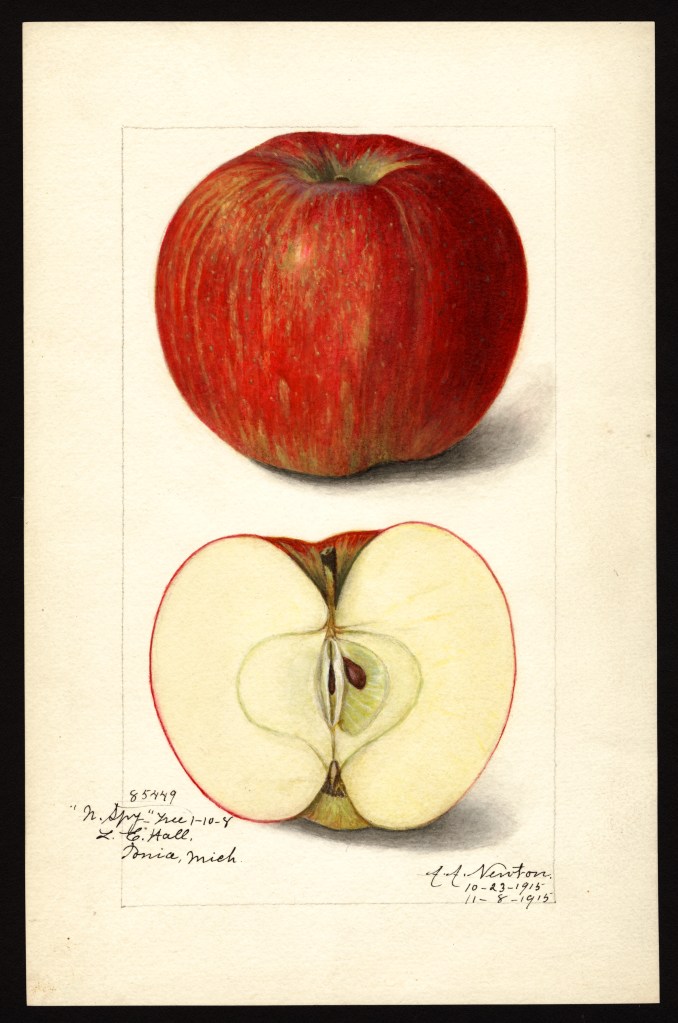
Northern Spy – (Also known as Spy and Northern Spice). The Crossnore Heritage Orchard has one Northern Spy,Tree, #27. The Northern Spy apples begin ripening in early October. I first found older Northern Spy trees at an expert apple, Jack Banner’s Orchard on Sugar Mountain #1; and others at Ross & Lynn Church’s’ as well as Rich Minford’s’ family farms on Sugar Mountain. Please share with us your stories, if you have some on the Northern Spy. We can post them on this website, if you wish.
The Northern Spy is a true northern heirloom apple variety. It originated from seed planted about 1800 in East Bloomfield, New York. It grows well in our mountain area but may not grow good tasting fruit in the North Carolina piedmont or further south. Our area enjoys several northern apple varieties because of our elevation. It’s been used by many branches of the Banner family tree for cider and apple butter.
The Northern Spy apples have a “greenish yellow base color nearly concealed by glossy bright pinkish red with carmine and overlapped with a thin delicate bloom”. The apples have flesh that is fine textured, rather firm, tender, crisp, very juicy, with a sprightly sweet flavor. Its very good for dessert, kitchen, or market use.” The Northern Spy blooms later than most, stores quite well, and is known as a great pie apple.
#28 Early Harvest (see #3)
#29 Avery Rusty Coat (Cole Orchard)
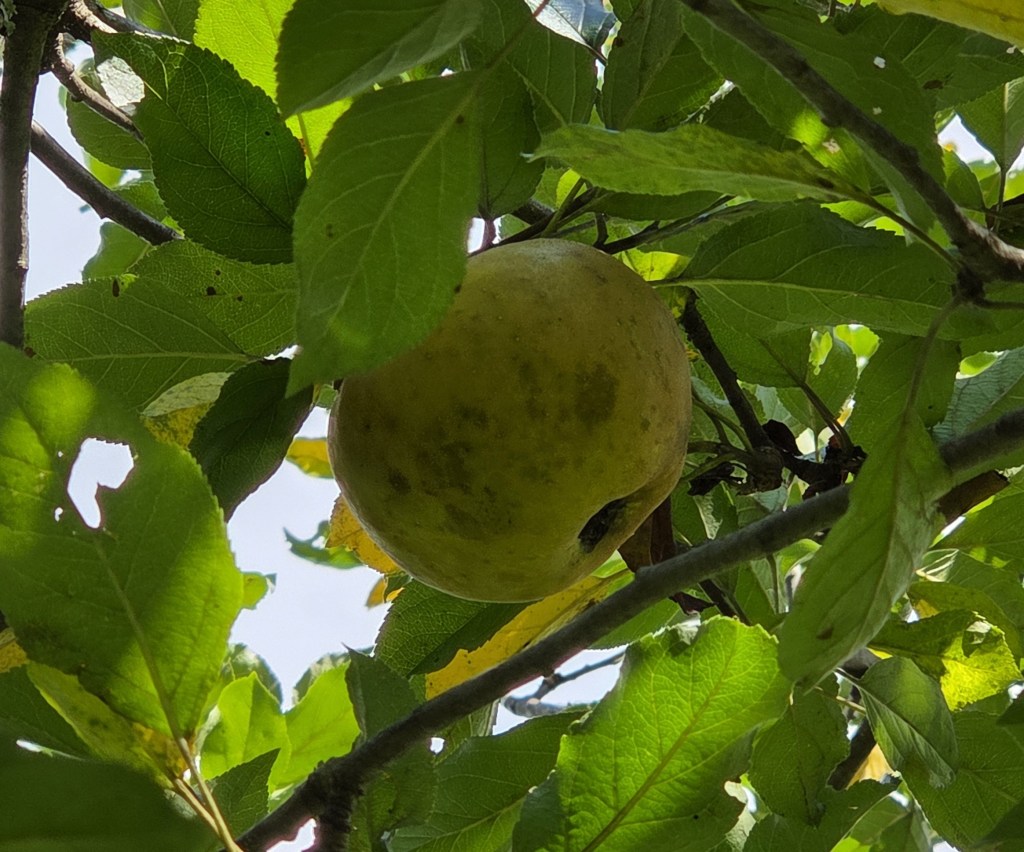
Avery Rusty Coat- (???). The Crossnore Heritage Orchard has one Avery Rusty Coat apple, Tree #29. It usually begins ripening in early September. Several of these local rusty coat apple trees grow along Cole Holler road, off of Old Toe River Road. We got the cuttings off the largest Old Avery Rusty Coat tree I knew of, in Charles and Betty Coles orchard looking down towards the North Toe River. I’ve been told of other Avery County Rusty Coats around Newland that are long gone now.
We are still trying to identify this apple. What I mean by that? Well there are many russeted apples in the Southern Appalachian Mountains. Most are true heirloom apples. But when the names of these cultivars have been forgotten folks tend to fall back on the name ‘Rusty Coat’. I believe this old russeted apple might be one of those. In 20+ years I have not been told its original name, so I’ve named it the ‘Avery Rusty Coat’ until we can get a more original name.
Our Avery Rusty Coat tree here in the Crossnore Heritage Orchard has just started bearing apples in recent years. Take a look at them in late August. If you think you recognize it, please let me know what you call it. Here is also a description and photo to help you. (-:
These apples are medium to large size apples, usually oblate (flattened), but irregular shaped too. They have evenly smooth russeted skin with little additional color. They are dry apples, not juicy, and quite sweet when ripe. Folks tell me that their Moms and Grand maws used to can them for preserves and how good they were! Of course these same ladies worried that ‘their men’ would try and make high strength Cider out of them. (-: Please do send me your stories if you have them. We welcome local history. We’ll post your stories, or not, your choice. Just let us know if you have the original name or any other name for this local Rusty Coat. Thanks in advance.
#30 Gragg
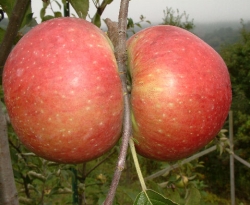
Gragg – (also known as the Winter Queen) We have one Gragg apple tree in the Crossnore Heritage Orchard, Tree #30. The apples begin ripening in early October but continue hanging on the tree for many weeks. A good friend and supporter of this orchard, Dallas Banner used to carry Gragg apples in his pockets to school in the winter months of the 1930s & 40s; In his own words, “just to have something to eat for lunch”. A long lived tree, we’ve found many 100 year old Gragg apple trees scattered across Avery County. Please share with us your stories, if you have some on the Gragg. We can post it on this website if you wish.
We understand the Gragg apple originated in the Globe community of Caldwell County about 1859 on the farm of James Gragg. The Gragg is an excellent baking apple, with beautiful red coloration over green skin and an oblate shape. Known as a trouble free apple, with a waxy tough skin, it bears annually and keeps better than about any apple. The Moses Cone Orchard had substantial numbers of Gragg apples listed in 1900. It is often the last tree in November with bright red apples still hanging on for our first snows.
#31 Grimes Golden (see #8)
#32 Wolf River (see #2)
#33 Golden Russet
“U.S. Department of Agriculture Pomological Watercolor Collection. Rare and Special Collections, National Agricultural Library, Beltsville, MD 20705”
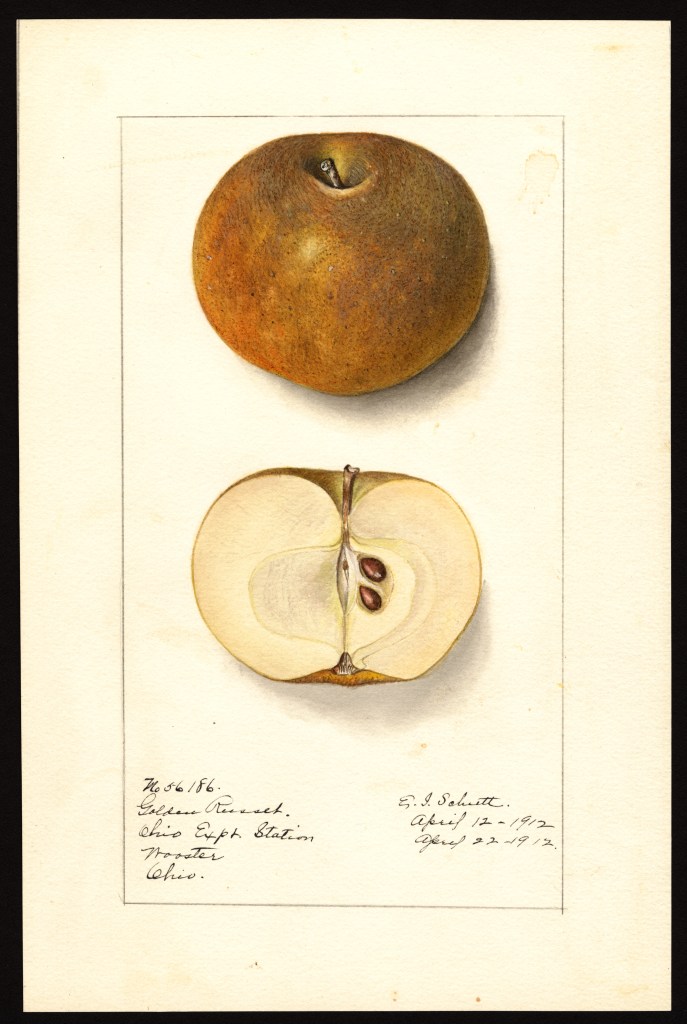
Golden Russet (also known as American Golden Russet, Rusty Coat, and Bullock Pippin).
We have two trees planted in our Crossnore Heritage Orchard, side by side, Trees #33 and #34.
These Golden Russets begin ripening in early October and continues throughout the month. We have found very few older Golden Russet trees in Avery County. Please let us know if you have any and want to share your stories about your American Golden Russet. We can post then on this website if you wish.
This Golden Russet may have been discovered in New Jersey in 1836 under the name Bullock Pippin. However, new research indicated there may be other lineages for this particular Rusty Coat. It is known for excellent fresh eating, pie making, cider and drying qualities. It is also known today as a prominent cider apple in today’s new cider renaissance. It is a true russeted apple completely covered in an “old gold” russet finish. It’s a uniform medium size apple on a vigorous growing tree in our area. It is certainly one of the best quality Rusty Coat apples in Avery County.
#34 Golden Russett (see #33)
#35 Carolina Red June (see #13)
#36 Blacktwig
“U.S. Department of Agriculture Pomological Watercolor Collection. Rare and Special Collections, National Agricultural Library, Beltsville, MD 20705”
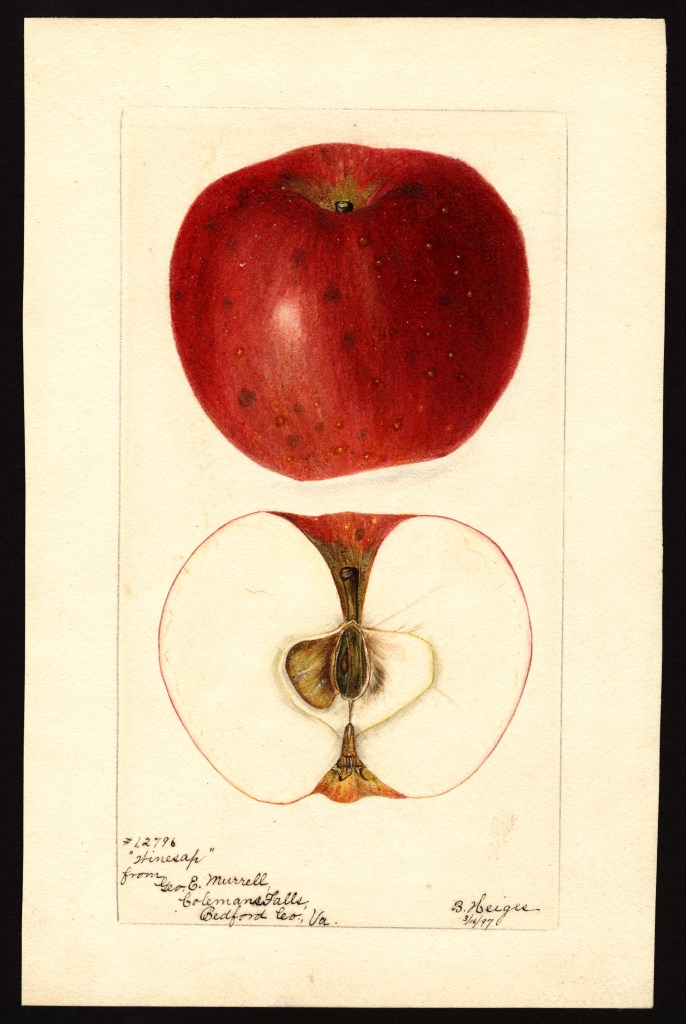
Blacktwig – (also known as ‘Mammoth Blacktwig’). We have two Blacktwig apple trees in the Crossnore Heritage Orchard, Trees #36 and #39. The Blacktwig apples begin ripening in early-October and continue throughout the month. We’ve found many older Blacktwig trees located across Avery County and perhaps the oldest was in Dulce Stamey’s old orchard on Horney Rd.
The Blacktwig was one of Lee Calhoun’s’ favorite American apples, well described in his book “Old Southern Apples”. It was a seedling from a Winesap discovered in 1842 in Arkansas. Before 1900 the word “Blacktwig” was commonly used interchangeably for Winesap. But this Winesap was so much larger than an Original Winesap it was named the Mammoth Blacktwig. Freshly picked it has a winey/tart flavor and keeps very well in storage. In storage it becomes sweeter and more flavorful about Christmas. Nothing can touch the flavor of this apple during the winter and it is one of the best for “baked and pie apples”. It is a vigorous growing tree, bears annually, and quite easy to grow in Avery County. The Avery Extension Plant Sales often has the Blacktwig trees available each March.
#37 McIntosh (see #1)
#38 Newtown Pippin (see #7)
#39 Blacktwig (see #36)
#40 Original Winesap
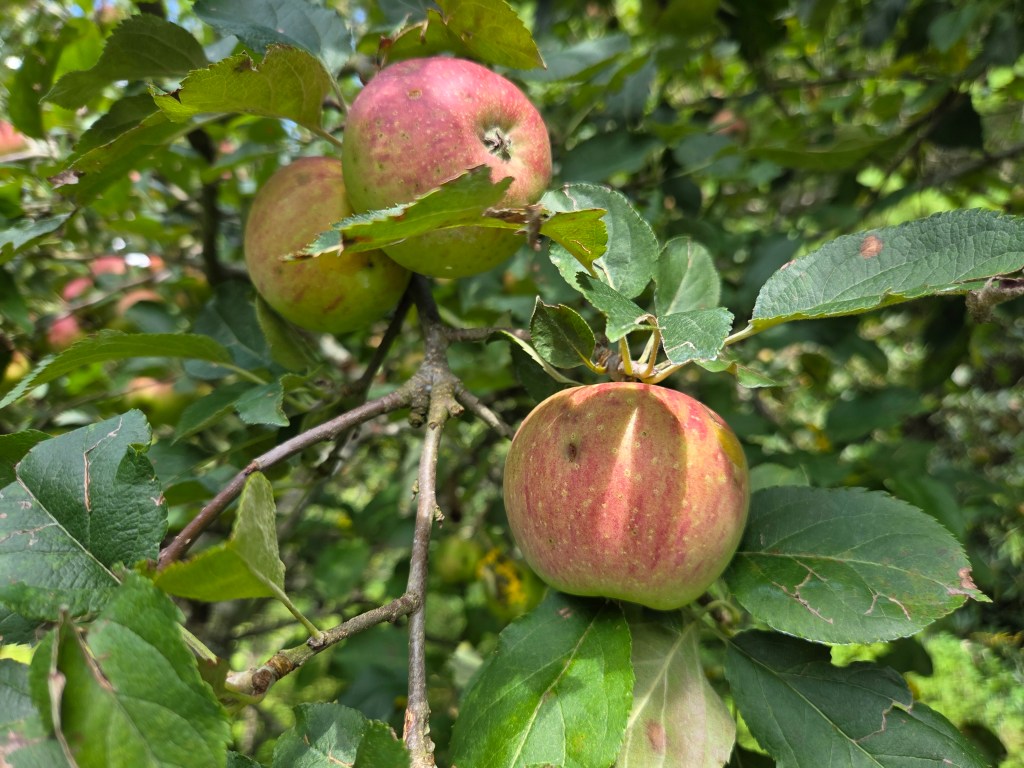
Original Winesap (Old Fashioned Winesap, Holland Red Winter, Blacktwig) – The Crossnore Orchard has one Original Winesap apple tree, Tree #40. Historically no other apple comes close to being as popular across the South as the many Winesaps, named for its delicious sprightly, winey flavor. The list of uses and attributes include, great flavor, fresh eating and baking, cider, reliable bearing each year, great storage time, turning more sweet over that time, excellent productivity and adaptability to different climates and soils. If you’ve got poor soil, plant Winesaps. There are over 20 different variations of the Original Winesap apple now. In our mountains we didn’t need Winesaps to grow great apples, but much of the South depended on them.
#41 Mother
“U.S. Department of Agriculture Pomological Watercolor Collection. Rare and Special Collections, National Agricultural Library, Beltsville, MD 20705”
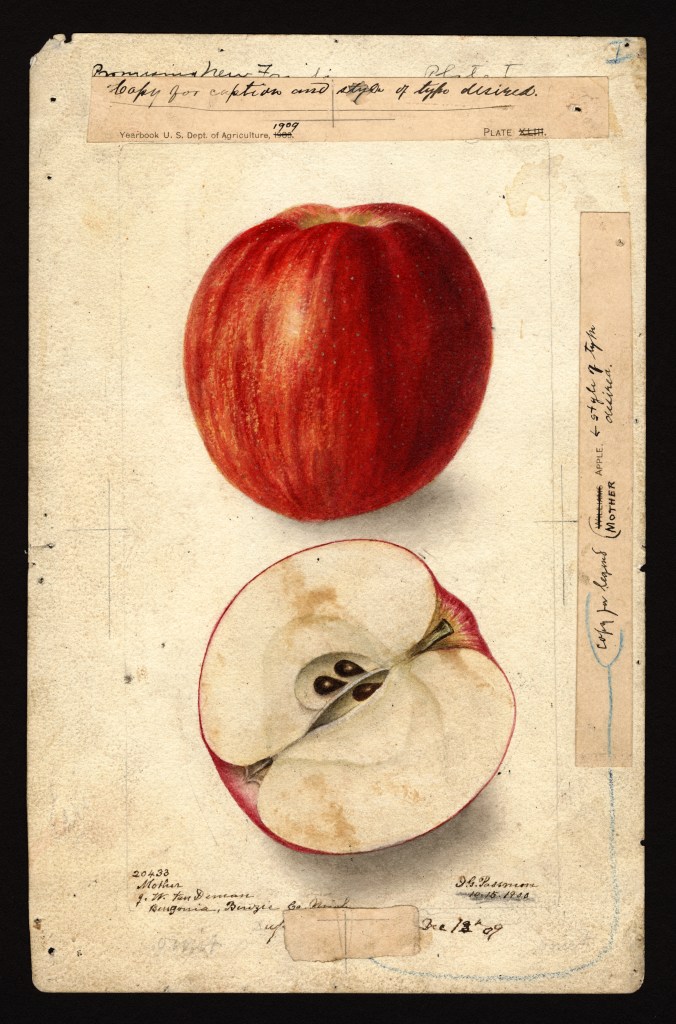
Mother apple – (Also known as American Mother & Mother Bud). The Crossnore Heritage Orchard has one Mother apple, Tree, #41. Our Mother apple begins ripening in mid-September and will continue into October. We’ve seen only a few Older Mother apple trees in Avery County. However, sweet stories abound about this apple from older folks. Please share with us your stories, if you have some on the Mother apple. We can post them on this website, if you wish..
American Mother originated in the nineteenth century on the farm of Gen. Stephen P. Gardner of Bolton, Massachusetts. It is well adapted to the South and was very well known in central North Carolina. Medium size fruit is slightly oblong with thin, smooth, golden yellow skin mostly covered with red splashes and striping. Flesh is yellow, fine-grained, tender and juicy with a pleasant aroma and a distinctly sweet flavor. It’s not the longest keeper in storage, but long-term storage is seldom required! A great American fresh eating apple also prized for making pies.
#42 Mystery Apple

Mystery Tree – (?????,??????). Yes, the Crossnore Heritage Orchard does have a Mystery apple tree. (-: We are confident it is an heirloom apple, but we don’t have a clue what it is. The Mystery tree is Tree #42 and it had some apples on it in July this year that appear to have disappeared? Hopefully we can identify next year (-:
Somehow we lost the identity of this tree when it was planted about 2014. It hasn’t had an apple on it yet, as far as I know! We’ll have more to tell you next fall when more apples are available! When we all get a look at them please feel free to give us your opinion on their identity.
Pomology, the study of apples, has been a scientific endeavor for at least a couple of hundred years. This work focuses on identifying apples by describing them in detail, by their many characteristics. Simply Google “The Apples of New York” by Beach, 1905 and read the lengthy pomolgical descriptions for yourself. I have utilized this book writing some of these apple descriptions.
#43 Old Seedling Apple (Mother Nature)
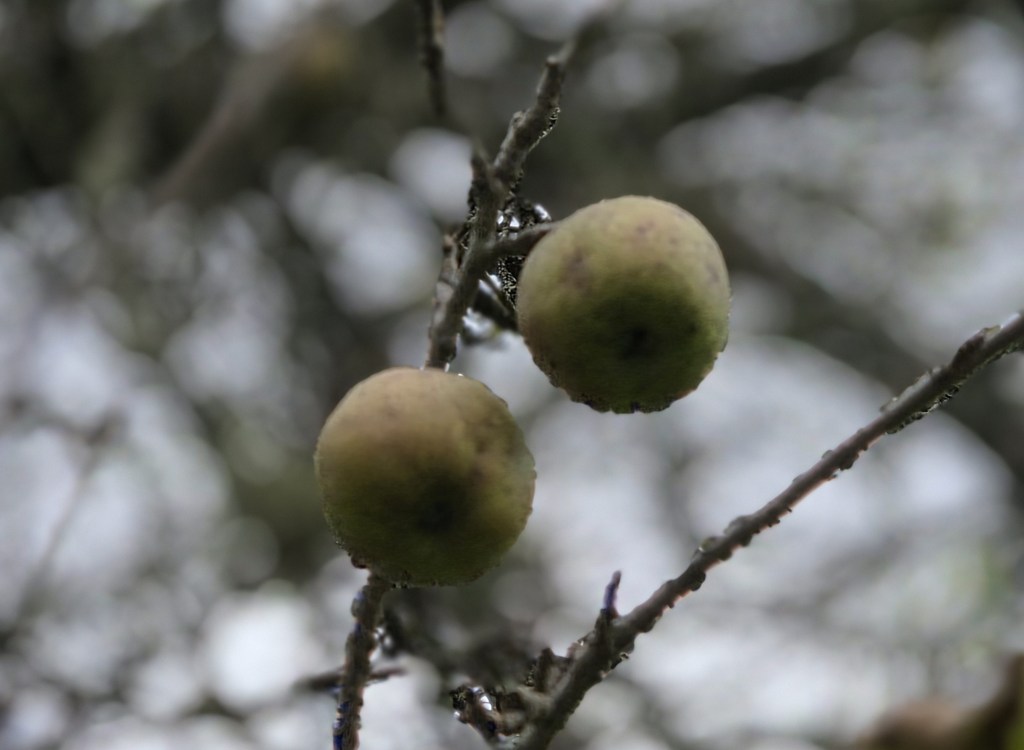
Old Seedling Apple –(also known as a Volunteer tree). The Crossnore Heritage Orchard has one Old Seedling Apple, Tree #43. Other Old Seedling Apple Trees grow across Avery County. Sometimes called ‘Volunteer’ trees by people who understand they grew from a seed and likely were accidental or unintended… They are apple trees that grow from a seed germinating, rather than having been grafted.
Just remember this, all the apple trees we normally buy from a retail business, have all been grafted. This is the only way to produce a specific variety of apple tree. Growing an apple tree from seed will produce an apple tree, but it will grow an original, new type of apple. Why, because all apples are naturally heterozygosis, much likes human beings. Just look at your brothers and sisters, they are all quite different people.
Sometimes these trees result from someone throwing an apple core from a car window while driving down a road. Years ago ‘farmer researchers’ planted seeds in nurseries, just to see what they would get.
For apples this means that if you plant a seed from an apple, the resulting tree will produce a new and different kind of apple, not necessarily resembling the parent. This is because apple trees are cross-pollinated, which leads to a random combination of genetic possibilities from both parent trees. Cross-pollination does allow fruit to grow normally. So the fruit will still be the same as the parent tree it grows on. However the seeds inside of that fruit will possess a very different genetic makeup than that of its parent tree.
So this Old Seedling apple tree was apparently grown from seed, possibly from some random occurrence, germinating some 40+ years ago. Now someone did allow this tree to grow and make fruit, thank you. We would love to know who remembers it as a young tree! (-:
The apples growing on our Old Seedling Tree appears to be a type of Rusty Coat? So perhaps its Mom or Dad was an Avery Rusty Coat? Avery Rusty Coats have been grown around here for at least 100 years.
Here is the reason we leave this Old Seedling Apple Trees in our orchard!
All the apple trees in the Crossnore Heritage Orchard, were all originally Seedling trees! Many of our ancestors, mostly from the British Isles and Western Europe, came to America in the 1600 and 1700s with apple seeds in their baggage. They planted their first orchards with these seeds, knowing they would grow unknown types of apples. Some would be sweet and some bitter, but harvested together they would be pressed into a very useful juice we called Apple Cider. The apple cider they didn’t drink quickly, would be fermented and stored for the winter and months ahead for long term use.
Our ancestors were very familiar with apples. They grew and utilized apples for a variety of uses for hundreds of years in their home countries. They knew that among the seedling apple trees that grew perhaps 1 in 100 would be very good; They would have a lot of very average apples and some ‘Spitters’, but some would also be ‘Superior’ apples. These especially good apples might be very crisp or very sweet, or have excellent baking characteristics, good storage abilities, or make higher quality Apple Cider.
When they started bearing fruit, these trees were recognized for their qualities. Our ancestors would name these particular trees, and begin grafting them. All the Heirloom apples in the Crossnore Heritage Orchard have this origin story and all the other Heirloom apple varieties were discovered this same way. Heirloom apples are simply the best apples discovered by our ancestors over hundreds of years.
When these ‘superior’ apple trees were selected, they were shared with family and neighbors by grafting. As the American population crossed the Appalachian Mountains and spread westward scionwood for grafting was spread into the new states of the North and South.
It’s estimated there were at least 5,000 Heirloom apple varieties selected by our ancestors and still around in 1890. However, by 1980 we may have less than 750 varieties left. Over this 100 year period, home orchards in America largely disappeared. The reasons are numerous. Some may have been because of the increase of Industrial work opportunities in cities and the resulting loss of small family farms, plus the addition of supermarket availability in our culture.
Planting these apple varieties now in small home orchards and a few community orchards is a way to preserve these varieties and help keep these historic apples around a little longer. You can help by planting your own Heirloom apple trees or by donating to Community Orchards like the Crossnore Heritage Orchard.
